An Elder in your family wants photographs of her grandparents from the 1930s. Years ago, someone would have driven to a library far away and opened boxes by hand for weeks. Today a computer search looks through millions of records in minutes, and AI (artificial intelligence) can even sort the photos by what it sees. That same week, her phone rings. It sounds exactly like her grandson, crying and asking for money. AI can help us, and AI can be used to trick us. This class shows what AI really is, how it works, why we always check, and how to keep your family safe.
Start here1AI Is Not New, and Not One Thing2How AI Works, and Why We Check3Your Information, Your Choice4Fakes and ScamsPractice and quizWords and resources
Start hereWelcome
Listen to the story1:13
What you will learn
- Explain that AI (artificial intelligence) is a family of tools, not one thing, and name AI you already use every day
- Describe how a chatbot writes an answer, and why an answer that sounds sure can still be wrong
- Decide what is safe to type into a free AI app by using the community board test
- Spot AI voice and video scams, and protect your family with a code word, a call back, and a report
In this class
1AI Is Not New, and Not One ThingAI (artificial intelligence) is one word for a whole family of computer tools. Some kinds are more than 70 years old, and you already use them every day.4 pictures2How AI Works, and Why We CheckComputers are fast at searching. AI goes one step further: it learns patterns from many examples and makes a likely guess. Fast is not the same as right.5 pictures3Your Information, Your ChoiceInformation about you, your family, and our community is like our water. It starts with us, and we decide where it goes.1 picture4Fakes and ScamsAI can now copy a voice and a face from videos posted online. The tricks are new, but the warning signs are old: hurry, secrecy, and money that is hard to get back.3 pictures✓Practice and quizTry it yourself, the three things to remember, and a short quiz.
Part 1AI Is Not New, and Not One Thing
AI (artificial intelligence) is one word for a whole family of computer tools. Some kinds are more than 70 years old, and you already use them every day.
Listen to this part1:01
Read all 4 details
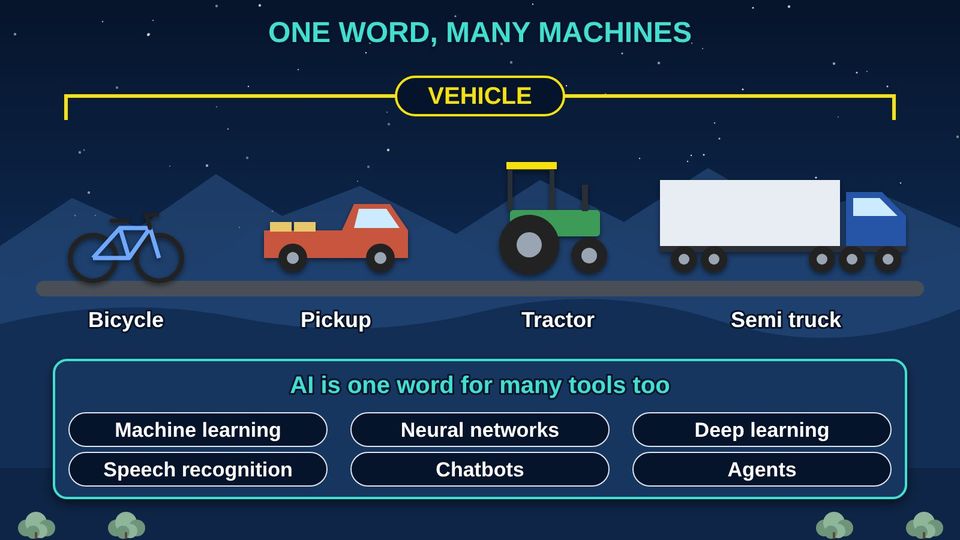
- 1One word, many machines. Vehicle is one word for many machines. AI (artificial intelligence) is one word for many different tools.
- 2Different jobs. A pickup hauls hay and a tractor works the field. Each kind of AI is built for its own job, like hearing speech, sorting photos, or writing drafts.
- 3Different rules. Anyone can ride a bicycle, but a semi needs a special license. Newer, more powerful AI needs more care and more checking.
- 4Ask which kind. When someone says we should use AI, ask: which kind, for what job, and with what information?
Listen to this picture0:48
Read all 5 details
- 1Spam folder. Your email learns what junk mail looks like from millions of examples and moves it aside. That is machine learning.
- 2Drive time. Your phone map estimates how long the drive to town will take using patterns from past traffic.
- 3Fraud alert. Banks use AI to spot a charge that does not fit your usual pattern and send you an alert.
- 4Face unlock. Many phones use a neural network to recognize your face before they unlock.
- 5Talk to type. When you talk to your phone to write a message, speech recognition turns your words into text.
Listen to this picture1:18
Read all 7 details
- 11952: hearing numbers. Researchers at Bell Telephone Laboratories built a machine that recognized the spoken numbers zero through nine.
- 21956: the name. Scientists chose the name artificial intelligence for a summer research meeting at Dartmouth College.
- 31958: the perceptron. The perceptron, an early neural network that could learn, was described. It is an ancestor of today's AI.
- 41959: machine learning. A checkers program got better by learning from its own games. Its creator called this machine learning.
- 52012: deep learning. A deep learning system did much better than earlier methods at recognizing what is in photos.
- 62022: chatbots. Public chatbots arrived, built on a 2017 design called the transformer.
- 72025: agents. AI agents that carry out multistep tasks for people became a focus, along with new safety testing.
Listen to this picture1:26
Read all 6 details
- 1Machine learning. One of the oldest and most proven kinds of AI, and the root the others grow from. It learns patterns from many examples instead of following written rules. Spam filters and fraud alerts use it.
- 2Neural networks. Layers of simple math units, loosely modeled on brain cells, that adjust as they learn. The trunk the newer branches grow from.
- 3Deep learning. Neural networks with many layers. Since 2012 it has made computers good at seeing photos and hearing speech, and it powers most modern AI.
- 4Speech recognition. Turns spoken words into text. Early versions date to 1952; deep learning made it good enough for everyday phones, meeting minutes, and language recordings, with permission.
- 5Chatbots. Large language models write by predicting the next word. Helpful for drafts, but they can sound sure and still be wrong.
- 6Agents. AI that plans and takes steps on its own, like sending email or filling in forms. Agents are the newest and least tested. Hidden instructions can hijack them, so a person should check and approve every action.
Part 2How AI Works, and Why We Check
Computers are fast at searching. AI goes one step further: it learns patterns from many examples and makes a likely guess. Fast is not the same as right.
Listen to this part1:05
Read all 4 details
- 1The old way. Someone drives to a library far away and searches boxes by hand. It can take weeks, and they may still miss photos.
- 2A computer search. A search tool looks through millions of records in seconds. Many libraries and archives now offer online searches like this.
- 3Where AI comes in. AI (artificial intelligence) goes further. It can look at the photos themselves and sort them by what it sees, like people, horses, or landscapes, even when no one wrote a label.
- 4The big idea. AI is a tool. It is fast at finding patterns, but it does not know our families, our history, or what matters to us.
Listen to this picture0:34
Read all 3 details
- 1Examples. AI is shown thousands of examples. Some photos show people, some show land.
- 2Patterns. The computer finds what the examples have in common. Nobody writes the rules by hand.
- 3A guess, not a fact. On a new photo it makes a guess. It says likely, not certainly. It can be wrong, especially with things it saw few examples of, like our own people and places.
Listen to this picture0:39
Read all 3 details
- 1You already use this. Your phone keyboard suggests the next word as you type. A chatbot works on the same idea, at a much larger scale.
- 2What it learned from. It learned patterns from a huge amount of written text. The National Institute of Standards and Technology (NIST) describes these models as predicting the next word.
- 3One word at a time. It writes by picking a likely next word, again and again. It is not looking anything up unless the app also searches the web or your files.
Listen to this picture0:34
Read all 3 details
- 1The confident guide. AI writes smoothly and sounds sure of itself, even when it has no real answer. Ask the same question twice and you may get two different answers.
- 2Confabulation. When AI states something false with confidence, experts call it confabulation, or hallucination.
- 3Check the source. Before you rely on an answer, open the document it points to and make sure it says what the AI claims.
Listen to this picture0:33
Read all 3 details
- 1Trusting the screen. People sometimes follow a phone map onto a closed road even when the signs say stop. Experts call this automation bias.
- 2The real signs. With AI, the real signs are the original source and what you already know about your own community.
- 3The guard. Ask where the answer came from, open that source, and trust what you can see. Look up from the screen before you act.
Using a chatbot well
Good first jobs
Drafting a letter or a flyer, explaining a hard word or form in plain language, practicing for a job interview, or brainstorming names for an event.
Always check
Dates, phone numbers, hours, laws, and anything about health, money, or benefits. Open the source or call the office.
Ask twice
Ask the same question again, or ask where the answer came from. If the answers do not match, slow down and check.
Part 3Your Information, Your Choice
Information about you, your family, and our community is like our water. It starts with us, and we decide where it goes.
Listen to this part1:05
Read all 4 details
- 1Where it comes from. Information about you, your family, our lands, and our culture starts with us, like snowmelt in the mountains.
- 2The headgate. You decide where your information goes, the way a headgate decides which fields the water reaches. For a Native nation, the right to govern its own information is called data sovereignty.
- 3Our fields. Your information should help you, your family, and your community first.
- 4Outside users. Many free AI (artificial intelligence) apps keep what you type, and some use it to train their AI unless you turn that off. What we post publicly, like family photos or language lessons, can be copied by outside AI, so think before you post.
The community board test, at home
Before you type anything into a free AI app, ask one question: would I pin this on the community board at the post office, for anyone to read?
Yes: go ahead
A recipe question, help wording a flyer for the bake sale, or a question about how something works. Nothing private.
No: keep it out
Social Security, bank, and card numbers, passwords, medical details, children's information, photos of IDs, and anything about another person that they did not agree to share.
Sacred stays out
Ceremonial knowledge and stories that are not meant to be shared stay out of AI apps. So do photos and recordings of Elders, unless they say yes.
Check your AI app's privacy settings
- Open the app's Settings and look for a Privacy or Data section.
- Find the setting about using your chats to improve or train the AI. Turn it off if you prefer.
- Look through your chat history and delete chats that hold personal information.
- Before you upload a photo or a file, ask the community board question again.
- Check the privacy settings on your social media too. Public posts, photos, and videos can be copied.
Part 4Fakes and Scams
AI can now copy a voice and a face from videos posted online. The tricks are new, but the warning signs are old: hurry, secrecy, and money that is hard to get back.
Listen to this part1:14
Read all 4 details
- 1Copied from online videos. AI (artificial intelligence) can copy a person's voice and face from recordings posted online. The FBI (Federal Bureau of Investigation) warns that criminals use this for fake calls, photos, and video chats.
- 2The family emergency. A caller sounds like a grandchild in trouble and asks for money fast. The FTC (Federal Trade Commission) warns that AI voice cloning makes this old scam more convincing.
- 3The boss's voice. A call or video that looks and sounds like a boss or a leader asks someone to send money or change bank details. A familiar voice alone is never proof.
- 4The warning signs. Hurry, secrecy, and money that is hard to get back, like wire transfers, gift cards, or cryptocurrency.
Listen to this picture0:54
Read all 4 details
- 1Fake photos. AI can make pictures of disasters or people that never existed, often used for fake charities and fake profiles.
- 2Fake video calls. Criminals have used live video calls with copied faces and voices of business leaders. Look for lag, odd eyes or hands, and voices that do not match, but do not count on spotting it.
- 3Changed recordings. A real video or voice message can be changed to put new words in someone's mouth. Before you share a shocking clip, find where it first came from.
- 4Check the source. Fakes keep getting better. Call the person back, check with the group the message claims to come from, and look for the same news from a source you trust.
Listen to this picture1:05
Read all 5 details
- 1Slow down. Scammers rush you so you do not think. Take a breath, even if it sounds urgent.
- 2Hang up and call back. Call the person back on a number you already know is theirs, not the number that called you.
- 3Family code word. Agree on a secret word only your family knows. Ask for it when a call does not feel right.
- 4Two people approve. Before you send money, talk with someone you trust. At work, two people approve any payment or change to bank details, and a voice or video alone is never enough.
- 5Report it. Report scams to the FBI (Federal Bureau of Investigation) Internet Crime Complaint Center (IC3) at ic3.gov, and to the FTC (Federal Trade Commission) at ReportFraud.ftc.gov. If you sent money, call your bank right away. Anyone can be fooled.
Why this matters
In 2024, people age 60 and older reported nearly $4.9 billion in losses to the FBI (Federal Bureau of Investigation) Internet Crime Complaint Center (IC3), in more than 147,000 complaints. Anyone can be fooled, so there is no shame in reporting.
Set up your family's guards
- 1Choose a code word
Pick a word or phrase only your family knows. Share it in person, not by text or social media, and make sure Elders and children know it.
- 2Save the real numbers
Put the phone numbers of family members, your bank, and the clinic in your phone, so you can hang up and call back on a number you know.
- 3Post with care
Make social media accounts private, and think twice before posting long videos of your voice and face.
- 4Agree on a rule
No money, gift cards, or cryptocurrency goes out because of a call or message until you call back and check.
- 5Know where to report
ic3.gov, ReportFraud.ftc.gov, your bank, and your local or tribal police.
ReviewPractice and quiz
Listen to the practice steps1:14
Try it at home
About twenty minutes, with your own phone or computer and your family.
- Find the AI you already use: open your email's spam folder, check the drive time on your phone map, and try talking to your phone to type a message.
- If you use a chatbot, ask it a question you already know the answer to, like the hours of your community center or the history of your town. Write down what it gets right and wrong.
- Ask the same question a second time, then ask, "Where did that answer come from?" Open the source it gives and check it.
- Open the chatbot app's Settings. Find the privacy or data setting about training, and delete any chats that hold personal information.
- At your next family meal, choose a family code word. Make sure Elders and children know it, and do not post it anywhere.
- Save the real phone numbers of family members and your bank in your phone, so you can hang up and call back.
Remember
AI is a family of tools
Fast is not the same as right: check
Hang up, call back, use a code word
Check what you learned
1. Your email moves junk mail to a spam folder on its own. Is that AI (artificial intelligence)?
Spam filters learn what junk mail looks like from many examples. AI has been part of everyday tools for years.
2. You ask a chatbot what time the clinic opens on Saturday. It answers right away and sounds sure. What do you do?
AI (artificial intelligence) can sound certain and still be wrong. Experts call this confabulation. The clinic's own website or phone line is the real source.
3. How does a chatbot write an answer?
Like the word suggestions on your phone, it predicts one word at a time. That is why it can sound smooth and still be wrong.
4. Your niece wants help writing a letter to her landlord about a broken heater. What should she type into a free AI (artificial intelligence) app?
Use the community board test. She can add her name and address herself after the AI writes a draft.
5. Your "grandson" calls crying and asks for gift cards right away. What helps most?
AI (artificial intelligence) can copy a voice. A code word only your family knows, and a call back on a number you know, prove who is really calling.
ResourcesWords and resources
Words to know
- Artificial intelligence (AI)
- One word for a whole family of computer tools that find patterns in many examples and use them to make answers, suggestions, or decisions. It is not new: the name dates to the 1950s.
- Machine learning
- One of the oldest and most proven kinds of AI. It learns patterns from examples instead of following rules a person wrote.
- Deep learning
- Neural networks with many layers. It made computers good at seeing photos and hearing speech.
- Speech recognition
- AI that turns spoken words into text.
- Chatbot or large language model (LLM)
- AI that writes by picking the next most likely word, again and again. Helpful for drafts, but it can sound sure and still be wrong.
- AI agent
- The newest kind of AI. It plans and takes steps on its own to finish a task, like sending email or filling in forms. It is the least tested, so a person should approve every action.
- Prompt
- The question or instruction you give an AI tool.
- Confabulation (hallucination)
- An answer that sounds sure of itself but is false.
- Automation bias
- Trusting a machine more than what you can see for yourself.
- Public AI tool
- A free or paid AI app or website that anyone can use. What you type may be kept by the company, so only information you would pin on the community board goes in.
- Data sovereignty
- The right of a Native nation to govern the collection, ownership, and use of its own information.
- Deepfake
- A fake photo, video, or recording made with AI to look and sound real.
- Voice cloning
- AI that copies a person's voice from recordings so a caller can sound like them.
- Family code word
- A secret word only your family knows, used to check that a caller is really family.
- Wire transfer
- Money sent directly from one bank account to another. Once it is sent, it is very hard to get back, which is why scammers ask for it.
- Internet Crime Complaint Center (IC3)
- The FBI (Federal Bureau of Investigation) office where anyone can report online crime and scams, at ic3.gov.
Learn more
- FTC: Scammers use AI to enhance their family emergency schemesHow voice cloning works in the grandchild scam, and what to do.
- FBI IC3: Criminals use generative AI to commit fraudThe FBI's warning about fake voices, photos, and video calls, with tips.
- FBI IC3: Report an internet crimeWhere anyone can report an online or phone scam.
- FTC: ReportFraud.ftc.govReport a scam to the Federal Trade Commission and get next steps.
- NIST: Artificial IntelligenceThe national standards agency's plain overview of its AI work.
- CISA: Artificial IntelligenceWhat the national cyber defense agency says about using AI safely.
For teachers and digital navigators: how to run this class (60 minutes)
Lesson plan
- 5 minRead the story. Ask: has anyone had a call or message that did not feel right?
- 12 minPart 1: the vehicles and everyday pictures. Show of hands: who has used a spam folder, a phone map, or talk to type? That is AI.
- 13 minPart 2: how AI learns and writes. Live demo: ask a chatbot a local question everyone knows the answer to, ask it twice, and check the source together.
- 10 minPart 3: the water picture and the community board test. Read examples aloud and have the group call out yes or no.
- 12 minPart 4: fakes and scams. Each person writes a possible family code word on a card to take home, and saves one real family number in their phone.
- 8 minQuiz together with a show of hands, then the three Remember cards and where to report.
What you need
- Projector or large TV for the slides
- Printed handouts, one per person
- Index cards and pens for the family code word activity
- Optional: a laptop with a chatbot for a live demonstration, using only public questions
- Participants' own phones
Talk about it
- Where have you already seen AI in your day, maybe without knowing it?
- What would you never type into a free AI app? Why?
- How would your family know a call is really from one of you?
The PowerPoint slides follow this plan, with the story and every picture detail in the speaker notes.
References
- Apple. (n.d.). About Face ID advanced technology. Apple Support. https://support.apple.com/102381
- Dartmouth College. (n.d.). Artificial intelligence (AI) coined at Dartmouth. https://home.dartmouth.edu/about/artificial-intelligence-ai-coined-dartmouth
- Federal Bureau of Investigation. (2024, December 3). Criminals use generative artificial intelligence to facilitate financial fraud (Alert No. I-120324-PSA). Internet Crime Complaint Center. https://www.ic3.gov/PSA/2024/PSA241203
- Federal Bureau of Investigation. (2025). Internet crime report 2024. Internet Crime Complaint Center. https://www.ic3.gov/AnnualReport/Reports/2024_IC3Report.pdf
- Federal Trade Commission. (2020, October 22). FTC announces new fraud reporting platform for consumers: ReportFraud.ftc.gov [Press release]. https://www.ftc.gov/news-events/news/press-releases/2020/10/ftc-announces-new-fraud-reporting-platform-consumers-reportfraudftcgov
- Gregersen, E. (2026, October 7). ChatGPT. Encyclopaedia Britannica. https://www.britannica.com/technology/ChatGPT
- Krizhevsky, A., Sutskever, I., & Hinton, G. E. (2012). ImageNet classification with deep convolutional neural networks. In Advances in Neural Information Processing Systems 25. https://papers.nips.cc/paper/2012/hash/c399862d3b9d6b76c8436e924a68c45b-Abstract.html
- National Institute of Standards and Technology. (2024). Artificial intelligence risk management framework: Generative artificial intelligence profile (NIST AI 600-1). https://doi.org/10.6028/NIST.AI.600-1
- National Institute of Standards and Technology. (2025, January 17). Technical blog: Strengthening AI agent hijacking evaluations. https://www.nist.gov/news-events/news/2025/01/technical-blog-strengthening-ai-agent-hijacking-evaluations
- Puig, A. (2023, March 20). Scammers use AI to enhance their family emergency schemes. Federal Trade Commission Consumer Advice. https://consumer.ftc.gov/consumer-alerts/2023/03/scammers-use-ai-enhance-their-family-emergency-schemes
- Rosenblatt, F. (1958). The perceptron: A probabilistic model for information storage and organization in the brain. Psychological Review, 65(6), 386–408. https://doi.org/10.1037/h0042519
- Samuel, A. L. (1959). Some studies in machine learning using the game of checkers. IBM Journal of Research and Development, 3(3), 210–229. https://doi.org/10.1147/rd.33.0210
- Spicer, D. (2021, June 9). Audrey, Alexa, Hal, and more. Computer History Museum. https://computerhistory.org/blog/audrey-alexa-hal-and-more/
- Vaswani, A., Shazeer, N., Parmar, N., Uszkoreit, J., Jones, L., Gomez, A. N., Kaiser, L., & Polosukhin, I. (2017). Attention is all you need. In Advances in Neural Information Processing Systems 30. https://research.google/pubs/attention-is-all-you-need/
Questions about internet service for your community?
Our team is happy to help guide your community's broadband plan.
Contact our team