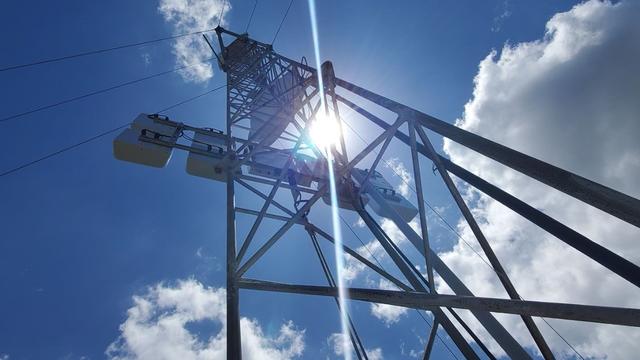
A cell phone is a two-way radio. Instead of one big station covering a whole region, phone companies, and tribes that run their own networks, use many smaller towers, each like a little radio station for its own neighborhood. Your car radio dial runs from 88 to 108. The cell phone dial is much wider, and it is divided into bands, each with its own name. This class shows how it all fits together, from the tower on the hill to the 5G (fifth-generation) symbol on your screen.
Start hereWelcome
Listen to the story1:00
What you will learn
- Explain why it is called a cell phone and what a cell site does
- Describe why low bands reach farther and high bands carry more
- Read a band name like n41 and know what it means
- Explain 5G's two ranges, FR1 and FR2 (Frequency Range 1 and 2), and which one serves rural areas
In this class
1PhonesA cell phone is a two-way radio. See how the land is divided into cells and what sits on the tower that serves yours.2 pictures2BandsThe airwaves are divided into named bands. Lower bands reach farther; higher bands carry more.4 pictures35GEach generation, from 2G to 5G, added speed and room. 5G sorts its bands into two ranges, FR1 and FR2 (Frequency Range 1 and 2).2 pictures✓Practice and quizTry it yourself, the three things to remember, and a short quiz.
Part 1Phones
A cell phone is a two-way radio. See how the land is divided into cells and what sits on the tower that serves yours.
Listen to this part1:21
Read all 4 details
- 1Cells. Think of each cell tower as a small radio station that only covers its own neighborhood, called a cell. Cells fit together like a honeycomb, which is where the name "cell phone" comes from.
- 2A tower for each cell. Each cell has a tower or radio site that serves the phones inside it. Neighboring towers use different channels, the same way two nearby radio stations use different spots on the dial so they do not talk over each other.
- 3The handoff. When you drive out of range of an FM (frequency modulation) station, the music fades to static and you have to find a new station. Your phone does this for you automatically, switching to the next tower in a split second so your call keeps going. This is called a handoff.
- 4A two-way radio. A car radio only listens. A cell phone is a two-way radio: it listens to the nearest tower and also talks back, and the tower connects your call or data to the rest of the network.
Listen to this picture1:03
Read all 5 details
- 1Antennas. Antennas near the top usually point three ways. Each one covers a slice about one third of a circle, so together they cover all directions.
- 2Height. Like a radio station's tower, cell towers are often 50 to 200 feet tall. Higher antennas see over hills and trees, so the signal reaches farther.
- 3Radios and power. At the base, a small building or cabinet holds the radios, batteries, and power equipment that keep the site running, even during an outage.
- 4Backhaul. Each site needs a link back to the main network. That link, called backhaul, can be fiber in the ground or a microwave radio beam to another tower.
- 5Shared towers. One tower can hold antennas for several phone companies. Sharing towers saves money and means fewer towers on the land.
Part 2Bands
The airwaves are divided into named bands. Lower bands reach farther; higher bands carry more.
Listen to this part1:32
Read all 4 details
- 1Low band. Low frequencies, around 600 to 900 megahertz (MHz, millions of wiggles per second), travel far and pass through walls and trees, the same way a low-frequency AM (amplitude modulation) station can still be heard after an FM station has faded. They are great for wide rural areas, but they carry less data.
- 2Mid band. Mid frequencies, like 2.5 and 3.5 gigahertz (GHz, billions of wiggles per second), balance distance and speed. In 2020, many tribes received 2.5 GHz licenses to serve their own lands.
- 3High band. Very high frequencies, called millimeter wave, can be extremely fast, but they only reach a short distance and are blocked by walls, trees, and even rain.
- 4The FCC. Radio frequencies are a shared public resource. Just as the Federal Communications Commission (FCC) assigns each radio station its frequency and call sign, it divides phone frequencies into bands, like lanes on a highway, and licenses who may use each lane in each area.
Listen to this picture2:40
Read all 6 details
- 1Low band. The 600, 700, and 850 megahertz (MHz) bands are the low notes of the cell dial. Like an AM station you can hear across a whole valley, they reach many miles and pass through walls, trees, and hills, but carry less data. The 600 MHz band was cleared for phones by moving TV stations, in an FCC auction that closed in 2017.
- 2Mid band. AWS (Advanced Wireless Services, 1.7 and 2.1 GHz) and PCS (Personal Communications Service, 1.9 GHz) carry much of everyday 4G LTE traffic. They balance reach and speed, a bit like FM: clearer and faster than AM, but not heard as far away.
- 32.5 GHz and tribes. The 2.5 GHz band runs from 2496 to 2690 MHz. In 2020 the FCC's Rural Tribal Priority Window let tribes apply for licenses in this band covering their own lands, and the FCC auctioned the remaining licenses in 2022 (Auction 108). Many tribal networks run here.
- 4CBRS and C-band. CBRS (Citizens Broadband Radio Service, 3.55 to 3.7 GHz) is shared in three tiers: existing users come first, then Priority Access License holders, then General Authorized Access users, who need no license but must yield to the others. The C-band (3.7 to 3.98 GHz) and the 3.45 GHz band were auctioned for 5G between 2020 and 2022.
- 5High band. Millimeter wave bands at 24, 28, and 39 GHz carry huge amounts of data but only over short distances. Phone companies use them where crowds gather: stadiums, airports, and busy downtowns. The FCC auctioned them between 2018 and 2020.
- 6The gap. From about 7 to 24 GHz, phones mostly do not operate today. Those frequencies are busy with satellite links, radar, and the point-to-point microwave links that connect towers to each other.
Listen to this picture1:41
Read all 6 details
- 1B means 4G. Band names that start with B (or just a number) are 4G LTE (Long Term Evolution) bands. B12, for example, is a 700 MHz band used for rural coverage.
- 2n means 5G. Band names that start with a lowercase n are 5G bands. The n stands for NR, New Radio, the official name of 5G radio.
- 3A number, not a frequency. The number is a list number, not the frequency. Band n41 is not 41 GHz; it is the 2.5 GHz band. It works like a radio station's call sign: a short name that points to a spot on the dial.
- 4Same lane, two names. 4G and 5G can share the same frequencies. The 2.5 GHz band is called B41 for 4G and n41 for 5G. Many networks, including tribal networks, run both.
- 5Check your phone. A phone can only use the bands it was built for, the way an AM-only radio cannot pick up FM. Before buying a phone or joining a local or tribal network, check that the phone's specifications list that network's bands.
- 6Combining bands. Modern phones can use several bands at the same time, called carrier aggregation. It is like a car using several highway lanes at once: more lanes, more traffic, faster downloads.
Listen to this picture1:14
Read all 5 details
- 1Low band covers distance. Low band spreads a blanket of coverage for miles, reaching the ranch at the edge of the valley. It is like an AM station: heard far away, but with room for less data.
- 2Mid band for the town. The 2.5 GHz band reaches the whole town with plenty of speed for many homes. It is the sweet spot many tribal networks use: a balance of reach and capacity.
- 3Millimeter wave for crowds. Millimeter wave covers only a small area near the tower, but it can serve a big crowd at a rodeo, ball game, or county fair all at once.
- 4One tower, many bands. A single tower can send several bands at once, like one broadcast tower carrying several radio stations. Your phone picks the best one, or combines them.
- 5A home antenna helps. With fixed wireless internet, a small antenna on the outside of the home points at the tower. Mounted high and aimed well, it can reach farther and faster than a phone held indoors.
Part 35G
Each generation, from 2G to 5G, added speed and room. 5G sorts its bands into two ranges, FR1 and FR2 (Frequency Range 1 and 2).
Listen to this part1:33
Read all 5 details
- 12G. The "G" stands for generation. In the 1990s, second-generation (2G) networks made phone calls digital and added text messages. Most U.S. carriers have now turned off their 2G and 3G networks.
- 23G. In the 2000s, third-generation (3G) networks brought email and simple web browsing to phones.
- 34G LTE. In the 2010s, 4G LTE (fourth generation, Long Term Evolution) made streaming video, video calls, and app stores practical. It is still the main network in many rural areas.
- 45G. In the 2020s, fifth-generation (5G) networks add more speed, quicker response, and room for many more devices at once.
- 5Your own network. A Mobile Virtual Network Operator (MVNO) sells phone service under its own name using another carrier's towers. It is one way a tribe can offer its own branded mobile service without first building every tower.
Listen to this picture2:19
Read all 6 details
- 1Who decided?. 5G standards are written by 3GPP (the 3rd Generation Partnership Project), a worldwide group of phone companies and equipment makers. 3GPP sorted 5G radio frequencies into two Frequency Ranges, FR1 and FR2. 5G radio is called NR, for New Radio, which is why 5G band names start with the letter n.
- 2FR1. FR1 runs from 410 megahertz (MHz) to 7.125 gigahertz (GHz). It holds the low, mid, and upper mid bands, including 600 MHz, 2.5 GHz, and the C-band. Most 5G people use every day, and almost all rural 5G, is FR1.
- 3FR2. FR2 starts at 24.25 GHz. These are called millimeter waves because each wave is only about a centimeter long or shorter. Short waves can carry a lot of data, but they fade quickly.
- 4Channel width. A single 5G channel can be up to 100 MHz wide in FR1 and up to 400 MHz wide in FR2. Think of lanes on a highway: a wider lane moves more traffic at once. For comparison, one FM radio station uses a channel only 0.2 MHz wide.
- 5Reach and walls. FR1 signals can travel miles and usually get inside buildings. FR2 signals usually reach about a city block and are stopped by walls, leaves, rain, and even a hand over the phone. That is why rural networks are built mostly on FR1.
- 6Stretched to 71 GHz. In 3GPP Release 17, completed in 2022, FR2 was extended up to 71 GHz. The 57 to 71 GHz part (band n263) is for unlicensed use, like Wi-Fi.
ReviewPractice and quiz
Listen to the practice steps1:09
Try it at home
Use your own phone:
- Look at the top of your screen. Does it show LTE, 5G, 5G UW, or 5G+? Write down what you see at home and in town.
- On an iPhone, open Settings, then Cellular, then your line, and look for the network name. On Android, open Settings, then About phone, then SIM status.
- Walk outside and count the signal bars, then count them again in the middle of your home. Walls and roofs block higher bands.
- Find the nearest cell tower you can see from your home. Which direction do your bars get stronger?
- Check your address on the FCC (Federal Communications Commission) National Broadband Map, Mobile Broadband tab, to see the reported 4G and 5G coverage.
Remember
Your phone is a two-way radio
Low bands reach far; high bands carry more
5G has two ranges: FR1 for distance, FR2 for speed
Check what you learned
1. Why is it called a cell phone?
Coverage is split into areas called cells, each served by its own tower.
2. Which signal travels farthest and goes through walls best?
Lower frequencies travel farther and pass through obstacles. High band is fast but short-range.
3. Which 5G range covers most rural areas?
FR1 (Frequency Range 1) signals travel miles and get inside buildings. FR2 (Frequency Range 2) usually reaches only about a city block.
4. What does the n in band n41 stand for?
5G radio is called NR, for New Radio, so 5G band names start with n. Band n41 is the 2.5 gigahertz (GHz) band.
ResourcesWords and resources
Words to know
- 2G, 3G, 4G, 5G
- The G stands for generation. Each new generation of cell technology is faster and handles more phones.
- LTE
- Long Term Evolution. The 4G cell phone standard.
- NR
- New Radio. The official name for 5G radio, which is why 5G bands start with n.
- Band (cell)
- A named block of frequencies, such as B12 (4G) or n41 (5G). The number is a list number, not the frequency.
- FR1 / FR2
- Frequency Range 1 and 2. 5G's two groups of frequencies: FR1 from 410 MHz to 7.125 GHz, and FR2 (millimeter wave) from 24.25 GHz up.
- Millimeter wave (mmWave)
- Very high frequencies, 24 GHz and up, whose waves are only millimeters long. Very fast, very short reach.
- Carrier aggregation
- When a phone uses several bands at once to go faster, like a car using several highway lanes.
- 3GPP
- 3rd Generation Partnership Project. The worldwide group of phone companies and equipment makers that writes the 4G and 5G standards.
- AWS
- Advanced Wireless Services. Cell phone bands around 1.7 and 2.1 GHz, used mostly for 4G LTE.
- PCS
- Personal Communications Service. Cell phone bands around 1.9 GHz.
- C-band
- The 3.7 to 3.98 GHz band, auctioned by the FCC for 5G.
- CBRS
- Citizens Broadband Radio Service. The shared 3.55 to 3.7 GHz band with three tiers of users.
- EBS
- Educational Broadband Service. The FCC's name for the 2.5 GHz band, first set aside for schools. Tribes received licenses in it in 2020.
- MIMO
- Multiple Input, Multiple Output. Using several antennas at once to send more data.
- MVNO
- Mobile Virtual Network Operator. A phone company that rents space on another company's towers instead of owning its own.
- Spectrum
- The full range of radio frequencies, shared by radio, TV, cell phones, Wi-Fi, and more.
- GPS
- Global Positioning System. Satellites that let your phone find its location. Phones listen at 1575.42 MHz.
Learn more
- FCC National Broadband MapSee which mobile and home internet services are reported at your address.
- 3GPP: Release 17The 5G standards release that stretched FR2 up to 71 GHz (technical).
- FCC: AuctionsEvery FCC spectrum auction, with the bands, dates, and winning bidders.
- NTIA BroadbandUSA publicationsFree federal guides, including a broadband glossary and tribal toolkits.
For teachers and digital navigators: how to run this class (45 minutes)
Lesson plan
- 5 minStart here: read the story. Ask who has the most bars at home, and why.
- 10 minPhones: the honeycomb of cells and what sits on a cell site.
- 12 minBands: the spectrum highway, the cell phone dial, and reading a band name. Have people check what their phone shows.
- 8 min5G: the generations and 5G's two ranges, FR1 and FR2.
- 10 minPractice and quiz together, then the three Remember cards.
What you need
- Projector or large TV for the slides
- Printed handouts
- Participants' own phones
- Optional: a printed map of nearby towers
Talk about it
- Where around here do phones lose signal? What is in the way?
- Why might a tribe want its own wireless license, like the 2.5 GHz band?
- What would better coverage change for families, Elders, or emergency services here?
The PowerPoint slides follow this plan, with the story and every picture detail in the speaker notes.
References
- Federal Communications Commission. (n.d.-a). 600 MHz band. https://www.fcc.gov/600-mhz-band
- Federal Communications Commission. (n.d.-b). Auction 101: Spectrum frontiers - 28 GHz. https://www.fcc.gov/auction/101
- Federal Communications Commission. (n.d.-c). Auction 102: Spectrum frontiers - 24 GHz. https://www.fcc.gov/auction/102
- Federal Communications Commission. (n.d.-d). Auction 103: Spectrum frontiers - Upper 37 GHz, 39 GHz, and 47 GHz. https://www.fcc.gov/auction/103
- Federal Communications Commission. (n.d.-e). Auction 105: 3.5 GHz band. https://www.fcc.gov/auction/105
- Federal Communications Commission. (n.d.-f). Auction 108: 2.5 GHz band. https://www.fcc.gov/auction/108
- Federal Communications Commission. (n.d.-g). Auction 110: 3.45 GHz service. https://www.fcc.gov/auction/110
- Federal Communications Commission. (n.d.-h). Why do FM frequencies end in an odd decimal? https://www.fcc.gov/media/radio/fm-frequencies-end-odd-decimal
- Federal Communications Commission. (2021). Auction of flexible-use service licenses in the 3.7-3.98 GHz band closes. https://www.fcc.gov/document/fcc-announces-winning-bidders-37-ghz-service-auction
- National Telecommunications and Information Administration. (n.d.). Publications. BroadbandUSA. https://broadbandusa.ntia.gov/resources/publications
- Telecommunications Law Professionals. (2020, October 26). FCC grants 2.5 GHz licenses in Rural Tribal Priority Window. https://www.tlp.law/2020/10/26/fcc-grants-2-5-ghz-licenses-in-rural-tribal-priority-window/
- 3rd Generation Partnership Project. (n.d.-a). NR; User Equipment (UE) radio transmission and reception; Part 1: Range 1 standalone (3GPP TS 38.101-1). https://www.3gpp.org/ftp/Specs/archive/38_series/38.101-1/
- 3rd Generation Partnership Project. (n.d.-b). NR; User Equipment (UE) radio transmission and reception; Part 2: Range 2 standalone (3GPP TS 38.101-2). https://www.3gpp.org/ftp/Specs/archive/38_series/38.101-2/
- 3rd Generation Partnership Project. (n.d.-c). Release 17. https://www.3gpp.org/specifications-technologies/releases/release-17
Questions about internet service for your community?
Our team is happy to help guide your community's broadband plan.
Contact our team