At the community center, a grandmother holds up her phone. Her grandson set it up last summer, but he is away at school now, and the clinic wants her to see the doctor by video. Down the hall, a father is filling out a job application on his phone because the family laptop broke. Out on the ranch road, a family still has no service at all. In a town an hour away, a member who moved there for work wants to join the tribe's computer class but cannot make the drive. Every community has stories like these. A digital equity plan gathers them, finds the patterns, and turns them into a program the Nation runs for its own people. This guide walks your team through it, one step at a time, using free tools you can print and adapt.
Start here1Why Digital Equity Matters for Our Nation2Getting Organized3Data Sovereignty First, Then Listening4Writing the Plan5Running the Program and Paying for ItPractice and quizProgram tools and resources
Start hereWelcome
Listen to the story1:29
What you will learn
- Explain the five elements of digital inclusion and why a tribal-led plan is an act of sovereignty
- Organize a lead office, a core team, and a coalition, and set data rules based on the CARE (Collective benefit, Authority to control, Responsibility, Ethics) Principles before any survey
- Write a digital equity plan with a vision, barriers, assets, and measurable objectives in five areas
- Run and pay for a program with digital navigators, devices, classes, and help enrolling in Lifeline, then measure and report back
In this guide
1Why Digital Equity Matters for Our NationDigital equity is not only about cables and towers. It is about whether every member can see the doctor, apply for a job, take a class, and stay connected to family and culture.1 picture2Getting OrganizedA plan needs a home, a team, and a mandate. These steps give your work the authority and the people it needs to last.1 picture3Data Sovereignty First, Then ListeningBefore you ask a single survey question, agree on who owns the answers. Then listen widely and with respect, in ways that make it easy for people to take part.1 picture4Writing the PlanYour plan names what you already have, what stands in the way, and what you will change. Start with your assets: they are the strengths your program will build on.1 picture5Running the Program and Paying for ItA plan becomes real when people get help. Here is how to staff a program with digital navigators, offer devices and classes, fund it in 2026, and show what changed.2 pictures✓Practice and quizTry it yourself, the three things to remember, and a short quiz.
Part 1Why Digital Equity Matters for Our Nation
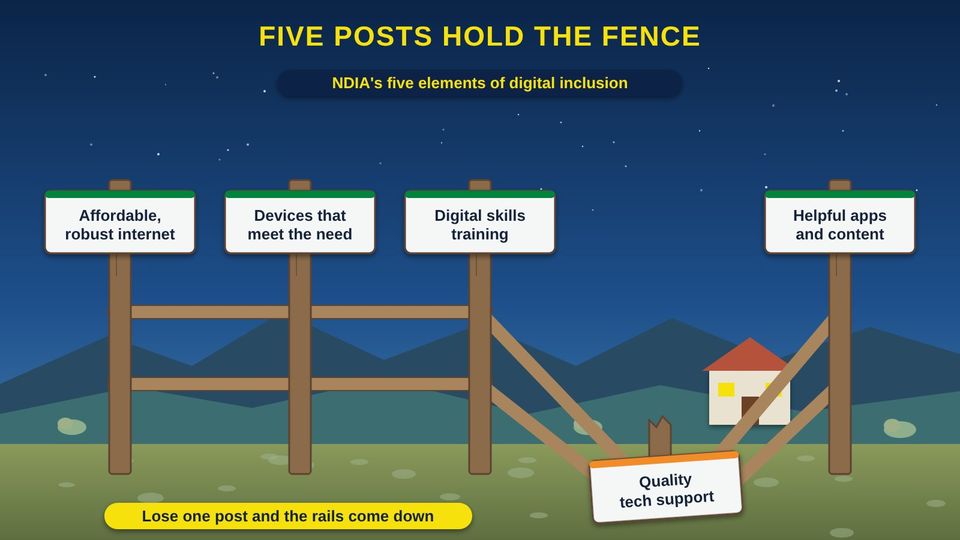
Digital equity is not only about cables and towers. It is about whether every member can see the doctor, apply for a job, take a class, and stay connected to family and culture.
Listen to this part2:02
Read all 6 details
- 1Affordable, robust internet. The NDIA (National Digital Inclusion Alliance) lists affordable, robust broadband first. A home connection has to be fast enough for school and video visits, and cheap enough that the family can keep paying for it.
- 2Devices that meet the need. A phone is not enough for every job. Filling out a job application or doing homework is much easier on a laptop or tablet with a keyboard. Devices should fit the person and the task.
- 3Digital skills training. People need a chance to learn: how to use email, keep accounts safe, and join a video call. Classes work best when they are local, patient, and taught by people the community trusts.
- 4Quality tech support. When a password is lost or a laptop will not start, someone has to be there to help. Without support, a family can have internet and a device and still be stuck. This post is down in the picture, and the fence fails.
- 5Helpful apps and content. Online services should help people take care of themselves and take part: telehealth, tribal services, school portals, and content in our own language and about our own community.
- 6A household needs all five. NDIA calls this whole set digital inclusion. Digital equity is the goal: a condition where everyone has the technology they need to take full part in society, democracy, and the economy. A plan has to work on all five posts, not just one.
Three words to start with
These definitions come from the National Digital Inclusion Alliance (NDIA), a national nonprofit that supports community digital inclusion programs. Numu Communications is a member.
Digital inclusion
"The activities necessary to ensure that all individuals and communities, including the most disadvantaged, have access to and use of Information and Communication Technologies." It is the work.
Digital equity
"A condition in which all individuals and communities have the information technology capacity needed for full participation in our society, democracy and economy." It is the goal.
Digital navigators
"Trusted guides who assist community members with ongoing, individualized support for accessing affordable and appropriate connectivity, devices, and digital skills." They are the people who do much of the work.
The federal Digital Equity Act defines these words in law at 47 U.S.C. 1721. Its definition of digital inclusion also includes awareness of online privacy and cybersecurity.
What the numbers say about Indian Country
Share these with your Council. They show why a plan made by and for the Nation matters.
| What was measured | What was found | Source |
|---|---|---|
| Households with broadband | 71% of American Indian and Alaska Native (AIAN) households on tribal land, compared with 84% of all AIAN households and 90% of all U.S. households | Census Bureau, 2021 American Community Survey |
| People without fixed 100/20 Mbps service | About 24% of people on Tribal lands, compared with about 7% nationally | Congressional Research Service, using FCC data from December 2022 |
| People who use the internet | 83% of AIAN people in 2023, up from 75% in 2021. 22% of AIAN people go online only by smartphone. | NTIA Internet Use Survey, 2023 |
| Survey of 160 tribal members | 18% had no home internet, 33% relied on cell service, and 50% said data caps limited their use | American Indian Policy Institute, 2019 |
Mbps means megabits per second. 100/20 means 100 Mbps download and 20 Mbps upload. FCC is the Federal Communications Commission, and NTIA is the National Telecommunications and Information Administration.
A tribal-led plan is an act of sovereignty
Digital sovereignty means the Nation decides how technology serves its people: who builds the network, what services are offered, how members are taught, and who controls the information gathered along the way.
State digital equity plans follow state rules. NDIA's State Digital Equity Plan Toolkit says plainly that tribal plan requirements will differ. Your plan does not have to copy a state plan. It should follow your own laws, values, and priorities, and it can still line up with federal rules so funders can read it easily. Part 4 shows how.
Part 2Getting Organized
A plan needs a home, a team, and a mandate. These steps give your work the authority and the people it needs to last.
Listen to this part1:43
Read all 6 details
- 1Organize. Start with a Council resolution that names a lead office and a core team. Put community members with lived experience on the team, such as an Elder, a parent, a student, and a veteran, not only staff.
- 2Listen. Before writing anything, find out what people need. Use a household survey, listening sessions at different times and places, and an inventory of the community assets you already have. Agree on data rules first.
- 3Plan. Write down a vision, the barriers people named, and measurable objectives in five areas. Share the draft for at least 30 days so the community can comment, and change it based on what you hear.
- 4Act. Run the program: digital navigators, device access, digital skills classes, and help signing up for Lifeline and low-cost plans. Partners such as the library, clinic, and school help carry the load.
- 5Measure. Track what you set out to change. Compare new numbers to your baseline, the starting numbers from your first survey, so you can show real progress to the Council, the community, and funders.
- 6Report back. Take the results back to the people who gave their time and answers. Then start the circle again: what changed, what did we miss, and what should we do next?
Four steps to get organized
- 1Pass a Council resolution
Ask the Council to support a digital equity plan, name a lead office, and set a timeline. A resolution shows staff, partners, and funders that the work belongs to the Nation.
- 2Choose a lead office and a coordinator
Pick an office that already serves many members, such as planning, education, the library, or the tribal technology office. Name one coordinator who keeps the work moving.
- 3Build a core team with lived experience
Include people who know the barriers firsthand: an Elder, a parent, a young adult, a veteran, a person with a disability, and a fluent language speaker. Pay or give stipends to community members for their time when you can.
- 4Grow a coalition of partners
Invite the library, clinic, school, tribal college, senior center, Head Start, housing, and workforce programs. NDIA's Digital Inclusion Coalition Guidebook, updated in July 2024 and drawn from 23 coalitions, has free advice on getting started.
Three ways people can take part
NDIA's planning toolkit describes three tiers of community engagement. Use all three.
| Tier | What it looks like | Who belongs here |
|---|---|---|
| Outreach | Sharing news: flyers, radio, social media, tribal newsletter, booths at events | Every member and household |
| Participation | Giving input: surveys, listening sessions, comments on the draft plan | Members, staff, partners, and internet providers |
| Partnership | Shared decisions: the core team and coalition that shape and run the plan | Community members and trusted partners. NDIA advises keeping internet providers out of this tier. |
Numu Communications is an internet provider too. We are glad to share data and listen, but your plan should be steered by your community.
Free support from NDIA
Affiliate membership
NDIA Affiliate membership is free. Affiliate+ is a paid level, priced by the size of your budget. Membership is open to local, state, Tribal, and federal governments and to nonprofits.
Seven Star Communities
NDIA's recognition program for Native entities, built with AMERIND Critical Infrastructure. Tribal governments, their chapters and pueblos, tribal organizations, and urban Indian organizations can apply.
Indigenous Digital Inclusion Working Group
NDIA and AMERIND host a monthly working group where tribal affiliates share what works. It is a good place to find mentors.
Digital navigator training
NDIA offers an 8-hour live digital navigator training, with a discount for Affiliate+ members. Check NDIA's website for the current price and upcoming dates.
NDIA's Digital Inclusion Trailblazers program is for local governments only (municipal, county, and regional). Seven Star Communities is the recognition built for tribal governments.
The seven stars
Seven Star Communities scores up to 25 points across seven stars. Earning 8 points earns Seven Star status, so you do not need everything at once. Your plan can help you earn several stars.
| Star | What it can mean for your Nation |
|---|---|
| Community Champion | A person or office that leads digital inclusion work |
| Planning Process | A digital equity plan made with the community, like the one in this guide |
| Tribal Government Support | Council action such as a resolution or budget |
| Tribal Resources | Tribal funds, staff, or facilities given to the work |
| Place-based Programs | Classes, navigators, device programs, and public computers in the community |
| Ecosystem Steward | A coalition of partners working together |
| Our Stories | Sharing what you learned and achieved, in your own voice |
The right-hand column gives examples to help you think. Check NDIA's Seven Star Communities page for the current scoring guide.
Part 3Data Sovereignty First, Then Listening
Before you ask a single survey question, agree on who owns the answers. Then listen widely and with respect, in ways that make it easy for people to take part.
Listen to this part1:45
Read all 6 details
- 1Answers start at home. Each household decides whether to answer. A plain consent statement on the first page says why you are asking, who will see the answers, and that people can skip any question or stop at any time.
- 2Authority to control. The A in the CARE Principles for Indigenous Data Governance stands for Authority to control. The Tribe owns the headgate: it decides where the answers go, who can use them, and for how long.
- 3Collective benefit. The C stands for Collective benefit. Most of the flow goes to the fields: your own plan, programs, and grant applications that help the whole community.
- 4Responsibility. The R stands for Responsibility. When funders or partners need data, send them totals and percentages only, never names. Report back to the community the same way.
- 5Ethics. The E stands for Ethics. Some gates stay closed. Answers are never sold, and never shared outside the Tribe unless people agreed to it and the Tribe approves.
- 6Locked storage. Before the first survey, write down where answers will be kept, who holds the key, and when paper forms will be destroyed. Keep names apart from answers, and use a code number instead.
The CARE Principles for Indigenous Data Governance
The CARE Principles (Carroll and others, 2020) put Indigenous rights and interests at the center of data work. Use them as your test for every survey, spreadsheet, and report.
| Principle | What it asks | In your digital equity plan |
|---|---|---|
| Collective benefit | Data should help the people it comes from | Use answers to shape programs, grants, and services for members |
| Authority to control | Indigenous Peoples decide how their data is gathered, used, and shared | The Council approves data rules; the Tribe owns all survey and program data |
| Responsibility | Those who use the data are accountable to the community | Report results back; share only totals with funders and partners |
| Ethics | Rights and wellbeing come first at every step | Get consent, protect privacy, never sell data, and plan how long to keep it |
Data rules to agree on before any survey
- The Tribe owns all survey answers and program records. Put this in writing, including in any agreement with a university, consultant, or vendor.
- A plain consent statement opens every survey: why you are asking, who will see the answers, and that people can skip questions or stop.
- Names and contact information are kept apart from answers. Use code numbers.
- You know where answers are stored, who has the key or password, and when paper forms are shredded.
- Only totals and percentages leave the Tribe. No names, addresses, or small groups that could identify a household.
- Results go back to the community before, or at the same time as, they go to anyone else.
- The Council or its delegate approves the rules, and any later request to use the data.
Listening to the community
- 1Make an asset inventory
List the places, people, programs, and funding that already help people get online. Use the Community Asset Inventory spreadsheet and NDIA's free asset mapping templates.
- 2Run a household survey
Use the Community Digital Needs Survey. Offer it on paper, in large print, online, by phone, and read aloud, and in your language. NDIA's toolkit recommends surveys in multiple languages and formats.
- 3Hold paid listening sessions
Meet at several times and places, in person and by phone or video. Offer childcare, rides, and a meal, and pay participants for their time, as NDIA's toolkit recommends.
- 4Talk with partners one by one
Ask the library, clinic, school, senior center, and housing office what they see every day, and what they could offer.
- 5Share back what you heard
Before writing the plan, tell the community what you heard and ask, did we get it right?
Reach the people a plan can miss
Federal law lists covered populations, groups that face the biggest barriers. After the July 2026 court ruling, the list is: low-income households (at or below 150% of the poverty level), aging individuals, incarcerated people, veterans, people with disabilities, people with language barriers, and rural residents. Here is how to reach them in tribal and rural communities, including members who live off the reservation.
| Who | Ways to reach them |
|---|---|
| Members who live off the reservation | Many members live in nearby towns, such as Winnemucca. Reach them through the enrollment office mailing list, tribal social media and newsletters, and classes held at a town library or partner site |
| Elders | Senior center lunches, home visits, phone calls, large-print surveys, a family helper who can read questions aloud |
| Veterans | Veterans organizations and events, the tribal veterans office, outreach through family members |
| People with disabilities | Accessible rooms, large print and audio formats, home visits, asking what support they need |
| Language speakers and people with language barriers | Surveys and sessions in your language, fluent speakers on the team, plain words and pictures |
| Rural and remote households | Paper surveys at the post office and store, mail-back envelopes, sessions in outlying areas, phone surveys |
| Low-income households | Food distribution, housing and assistance offices, paid participation, no cost to attend |
| Members who are incarcerated or returning home | Reentry and justice programs, with family consent and the facility's rules |
Part 4Writing the Plan
Your plan names what you already have, what stands in the way, and what you will change. Start with your assets: they are the strengths your program will build on.
Listen to this part1:44
Read all 6 details
- 1School and tribal college. Schools and tribal colleges have computer labs, teachers, and students who can serve as helpers. Ask about evening and summer use of labs.
- 2Tribal office. The tribal office is often the first place people go for help. Note its public Wi-Fi, any computers people can use, its hours, and who to contact. Your lead office for the plan may be here.
- 3Library. Libraries are strong partners: public computers, Wi-Fi, and staff who already help people online every day. Many can host classes and digital navigator hours.
- 4Senior center. Elders gather here. It is a good place for patient, one-on-one help and small classes, at times that fit the lunch schedule and the van rides.
- 5Health clinic. The clinic sees why telehealth matters. Ask what keeps patients from video visits, and whether the clinic could offer a private room with a good connection.
- 6Internet provider. List every provider, what they charge, and where they do and do not reach, like the homes out on the ranch road. Providers can share information, but the National Digital Inclusion Alliance (NDIA) toolkit advises keeping them out of the group that makes decisions about your plan.
The parts of a tribal digital equity plan
This outline follows the order of NDIA's State Digital Equity Plan Toolkit, adapted for a Nation. The Digital Equity Plan Template in Program tools has prompts and examples for each part.
- 1Introduction and vision
Who you are, why this plan matters, and the change you want to see in one or two sentences. Include the Council resolution.
- 2Collaboration and community engagement
Who was on the core team and coalition, how you listened, how many people took part, and your data rules.
- 3Barriers and assets
What your survey and listening sessions found, in people's own words, and the asset map of places, people, programs, and funding.
- 4Objectives and impact
Measurable objectives in five areas, each with a baseline, a target, a measure, a timeline, and a lead. Explain how meeting them helps jobs, education, health, civic life, and tribal services.
- 5Implementation
The strategies, partners, budget, and timeline, plus how you will measure progress and report back.
Objectives in five areas
These five areas match the objective areas in federal law. Each example names a baseline (where you are now), a target, and a date. Replace the brackets with your own numbers.
| Area | Example objective |
|---|---|
| Broadband availability and affordability | Raise the share of surveyed households with home internet from [baseline]% to [target]% by [date]. |
| Online access to public services | Put [number] tribal services online, in plain language and tested with Elders, by [date]. |
| Digital literacy | [Number] members finish a Learning Center class each year, and [target]% say they feel more confident. |
| Online privacy and cybersecurity | [Target]% of class participants set up a strong password and two-step sign-in by [date]. |
| Devices and technical support | Navigators give [number] client hours a month, and [target]% of households that asked for a device get one that meets their need. |
Make every objective measurable
Ask: could someone outside our team check whether we did this? "Help more people get online" cannot be checked. "Raise the share of surveyed households with home internet from our 2026 baseline to 75% by 2028" can.
Crosswalk to federal plan requirements
Funders may ask how your plan lines up with the plan contents listed in the Digital Equity Act at 47 U.S.C. 1723(c)(1). A crosswalk table shows them where to look without changing your plan's own shape.
| Federal plan content, 1723(c)(1) | Where it is in your plan |
|---|---|
| (A) Barriers faced by covered populations | Barriers and assets |
| (B) Measurable objectives for broadband availability and affordability, online accessibility of public services, digital literacy, online privacy and cybersecurity, and devices and technical support | Objectives and impact |
| (C) How the objectives affect economic and workforce goals, education, health, civic and social engagement, and essential services | Objectives and impact |
| (D) How you will work with key partners, such as anchor institutions, schools, nonprofits, and groups serving covered populations | Collaboration and community engagement; Implementation |
| (E) A list of organizations you worked with | Appendix: partner list |
Before the Council adopts the plan
- Post the draft for public comment for at least 30 days, as NDIA's toolkit recommends, in print and online.
- Hold at least one comment session in person and one by phone or video, at different times of day.
- Offer the draft in large print and share a short summary in your language.
- Keep a log of every comment and what you changed because of it.
- Bring the final plan and the comment log to the Council for adoption.
Part 5Running the Program and Paying for It
A plan becomes real when people get help. Here is how to staff a program with digital navigators, offer devices and classes, fund it in 2026, and show what changed.
Listen to this part2:29
Read all 6 details
- 1The digital navigator. NDIA (National Digital Inclusion Alliance) describes digital navigators as trusted guides who give community members ongoing, one-on-one help with affordable internet, the right device, and digital skills. A navigator from the community, who knows people and speaks their language, is often trusted most.
- 2The Elder sets the goal. The visit starts with what she wants: to see her doctor by video without driving two hours. The navigator listens first, then works on that goal step by step, at her pace.
- 3Lifeline. Lifeline is a federal discount on phone or internet service: up to $9.25 a month, or up to $34.25 a month on Tribal lands. Households at or below 135% of the federal poverty guidelines, or in a qualifying program, can apply at lifelinesupport.org. Tribal Link Up can also take up to $100 off installation.
- 4Telehealth. After the Lifeline step, the navigator helps her install the clinic's app, test the camera and sound, and practice a call. Doing it once together builds confidence for the real visit.
- 5Unique client IDs. NDIA's 2025 Digital Navigator Program Toolkit advises tracking each visit in four steps: intake, assessment, service, and follow-up. Use a client ID number instead of a name on the log, and keep the list that links IDs to names locked away.
- 6How many navigators?. NDIA's toolkit says one full-time navigator gives about 25 client hours a week. Pay ranges from $17 to $42 an hour, about $25 on average, or $40,000 to $65,000 a year. Plan three to six months to build a referral network.
Listen to this picture2:13
Read all 6 details
- 1Lifeline flows to households. Lifeline does not pay for your program. It lowers each qualifying household's own phone or internet bill, by up to $34.25 a month on Tribal lands. Your navigators help people apply at lifelinesupport.org.
- 2Tribal funds and partners. Tribal funds, in-kind help from the library, clinic, and school, and local partners are small streams, but they are steady and in your control. They keep a program running between grants.
- 3TBCP Round 3 and NEGP. In June 2026, NTIA (the National Telecommunications and Information Administration) opened Tribal Broadband Connectivity Program Round 3 and the Native Entities Grant Program, $790 million combined. Use-and-adoption awards run $500,000 to $2.5 million. Applications are due November 17, 2026.
- 4Digital Equity Act. The Digital Equity Act grants were terminated in May 2025. In July 2026 a federal court struck down one part of the law and kept the rest, but the ruling did not restore individual grants. NTIA plans a new notice for the Competitive program, targeted for December 2026.
- 5ACP has ended. The Affordable Connectivity Program (ACP) ended on June 1, 2024, after more than 23 million households had enrolled. Its Tribal benefit was up to $75 a month. Families who lost it may need help finding Lifeline or a low-cost plan.
- 6Keep more than one stream. A reservoir fed by one creek runs dry in a drought. Build your program on several sources, keep careful records, and report results, so you are ready when the next notice opens.
Four kinds of help your program can offer
Digital navigators
Trusted, one-on-one helpers. One full-time navigator gives about 25 client hours a week. NDIA's 2025 toolkit lists pay from $17 to $42 an hour (about $25 on average) or $40,000 to $65,000 a year.
Device access
Lending laptops and hotspots, refurbished computers, or devices through grants. Match the device to the need, and pair it with training and support.
Digital skills classes
Use the free Community Tech Resources classes in this Learning Center. Each one has slides, a handout, a poster, and a lesson plan, so staff can teach without building a course.
Affordability help
Help households apply for Lifeline, Tribal Link Up, and low-cost plans from local providers. Lifeline offers up to $34.25 a month on Tribal lands.
Ready-made classes for your skills program
Every Community Tech Resources class is free to print, present, and adapt.
| Learning Center topic | Good for |
|---|---|
| How Your Connection Works (networks and cell phones) | Understanding home internet, Wi-Fi, and cell service before choosing a plan |
| How Computers Work (devices, computer language, operating systems) | New device owners and people choosing a device |
| How Apps and Websites Work | Youth and adults curious about building and using apps and websites |
| Staying Safe and Smart Online (security and AI) | Everyone, especially Elders and families; supports your privacy and cybersecurity objective |
Starting a navigator program
- 1Hire from the community
Look for patience, trust, and good listening first. Technical skills can be taught, for example through NDIA's 8-hour navigator training.
- 2Set up the log
Use the Digital Navigator Toolkit spreadsheet. Track intake, assessment, service, and follow-up, with a unique client ID for each person and no names on the log.
- 3Build a referral network
List where to send people for devices, repairs, classes, benefits, and health and job services. NDIA's toolkit says this takes three to six months.
- 4Set hours where people already are
Senior center, library, clinic, tribal office, and outlying communities, on a regular schedule.
Funding and legal status change quickly
This guide is current as of October 2026. Check current notices from NTIA (the National Telecommunications and Information Administration), the FCC (Federal Communications Commission), and NDIA before you apply or make plans.
The 2026 funding landscape
| Source | Status as of October 2026 | What it can pay for |
|---|---|---|
| Tribal Broadband Connectivity Program (TBCP) Round 3 | Opened June 17, 2026. Up to $540 million. Applications due November 17, 2026 (amended deadline). Earlier rounds made 275 awards worth $2.2 billion. | Use-and-adoption awards of $500,000 to $2.5 million: adoption, digital inclusion, workforce, telehealth, and affordability subsidies. Devices with limits: no smartphones, one per household, for adults 18 and older who complete training. |
| Native Entities Grant Program (NEGP) | Opened June 17, 2026, alongside TBCP Round 3 ($790 million for both). At least $250 million. Due November 17, 2026. | Digital inclusion uses, including public computer centers. Every person served must be a member of a Native entity. |
| Digital Equity Act grants | Planning, Capacity, and Competitive grants were terminated in May 2025. A July 15, 2026 court ruling covers only the Competitive program and did not restore grants. NTIA plans a new notice, targeted for December 2026. Capacity program status is unresolved. | The law reserves not less than 5% for Indian Tribes, Alaska Native entities, and Native Hawaiian organizations. Watch for the new notice. |
| Lifeline and Tribal Link Up | Ongoing FCC programs. | Up to $9.25 a month, or up to $34.25 on Tribal lands, off a household's phone or internet bill. Tribal Link Up: up to $100 off installation. For households at or below 135% of poverty guidelines or in a qualifying program. |
| Affordable Connectivity Program (ACP) | Ended June 1, 2024, after more than 23 million households enrolled. No federal replacement. | Nothing now. Its Tribal benefit was up to $75 a month. |
| Tribal funds and local partners | Ongoing, in your control. | Staff time, space, matching funds, and steady support between grants. |
In November 2025, NTIA combined the remaining TBCP funds with the Native set-aside from the Digital Equity Act. TBCP affordability subsidies must be for service of at least 100/20 Mbps, be paid to the provider, and not duplicate Lifeline.
Measure, report back, and keep it going
- 1Measure against your baseline
Every 6 or 12 months, compare your navigator log, class sign-ins, evaluations, and a repeat survey to your starting numbers.
- 2Report back to the community first
Share results at a community meeting, in the newsletter, and on the radio before or when you send them to funders. Tell the stories as well as the numbers.
- 3Report to the Council and funders
Use totals only, with no names. Show progress on each objective and what you changed because of what you learned.
- 4Plan for the long run
Put core staff in the tribal budget when you can, keep several funding streams, train backups for each role, and update the plan every few years.
ReviewPractice and quiz
Listen to the practice steps1:16
Your first planning session
Do this with two or three coworkers or community members. It takes about 20 minutes and gives you a head start on the Community Asset Inventory.
- List five community assets: places, people, or programs that already help people get online. Think of the library, the clinic, a patient grandchild, a tribal college class.
- Write down the three barriers you hear about most. Use the words people use, such as "too expensive," "no signal out our way," or "I don't know who to ask."
- For each barrier, name which of the five fence posts it belongs to: internet, devices, skills, support, or helpful apps and content.
- Name three groups whose voices you have not heard yet, and one way to reach each.
- Write one draft data rule for your survey, such as "Only totals leave the Tribe."
- Pick a date to bring your list to your supervisor or the Council, and write it down.
Remember
A household needs all five posts
Our data, our consent, our control
Listen first, act, then report back
Check what you learned
1. A university offers to run your household survey for free, keep the answers, and publish a study. What fits the CARE (Collective benefit, Authority to control, Responsibility, Ethics) Principles?
Under the CARE Principles, the Tribe should own and control its data, so any partner needs a written agreement first.
2. Your first listening session was on a weekday evening, and only staff came. What is the best next step?
NDIA's (National Digital Inclusion Alliance) toolkit recommends meetings at several times and in different formats, with childcare and transportation help, and paying participants. It also advises keeping providers out of the partnership tier.
3. A family got a free laptop at an event, but it sits in the box because no one showed them how to set it up. Which posts of the fence are missing?
A device alone is not enough. Training and support, two of NDIA's (National Digital Inclusion Alliance) five elements of digital inclusion, help the family actually use it.
4. Which of these is a measurable objective for your plan?
A measurable objective has a baseline, a target, and a date, so anyone can check whether you met it.
5. Your Tribe is applying for a TBCP (Tribal Broadband Connectivity Program) Round 3 use-and-adoption award. Which device plan fits the rules?
Round 3 allows devices with limits: no smartphones, one per household, and only for adults 18 and older who complete training.
ResourcesProgram tools and resources
Program tools
Free to use, copy, and adapt for your community.
DOCXDigital Equity Plan TemplateA section-by-section plan with prompts, examples, an objectives table, and a federal crosswalk.DownloadDOCXCommunity Digital Needs Survey (Word)A 20-question, plain-language household survey with a consent statement. Edit it for your community.DownloadPDFCommunity Digital Needs Survey (PDF)The same survey in large print, ready to copy and hand out.DownloadXLSXCommunity Asset InventorySheets for places, people and programs, and funding, with example rows.DownloadXLSXDigital Navigator ToolkitIntake, assessment, service, and follow-up log with client IDs and an automatic summary.DownloadDOCXClass Sign-in and Evaluation Forms (Word)A sign-in sheet and a one-page class evaluation for any Learning Center class.DownloadPDFClass Sign-in and Evaluation Forms (PDF)The same forms, ready to print.Download
Words to know
- Digital inclusion
- The activities that make sure everyone can get and use technology: affordable internet, devices, skills training, tech support, and helpful apps and content.
- Digital equity
- The goal: a condition where everyone has the technology they need to take full part in society, democracy, and the economy.
- Digital literacy
- The skills to find, use, judge, and share information with a phone, computer, or the internet.
- Digital navigator
- A trusted guide who gives ongoing, one-on-one help with affordable internet, devices, and digital skills.
- Digital sovereignty
- A Nation's right to decide how technology, networks, and data serve its people.
- Data sovereignty
- A Nation's right to own and control data about its people, lands, and resources.
- CARE Principles
- Collective benefit, Authority to control, Responsibility, and Ethics. Principles for Indigenous data governance.
- Covered populations
- Groups named in the Digital Equity Act as facing the biggest barriers, such as aging individuals, veterans, and rural residents.
- Asset map
- A list or map of the places, people, programs, and funding a community already has to help people get online.
- Baseline
- Your starting number, such as the share of households with home internet in your first survey. Progress is measured against it.
- Coalition
- A group of partners, such as the library, clinic, and school, working together on a shared goal.
- NDIA
- National Digital Inclusion Alliance. A national nonprofit that supports community digital inclusion programs.
- NTIA
- National Telecommunications and Information Administration. The federal agency that runs tribal broadband and digital equity grants.
- TBCP
- Tribal Broadband Connectivity Program. NTIA grants for internet service and adoption on tribal lands.
- NEGP
- Native Entities Grant Program. An NTIA grant program, opened in 2026, for digital inclusion that serves members of Native entities.
- Lifeline
- A Federal Communications Commission program that lowers the monthly phone or internet bill for qualifying households, with a larger discount on Tribal lands.
- Tribal Link Up
- A Lifeline benefit that takes up to $100 off the cost of starting service on Tribal lands.
- ACP
- Affordable Connectivity Program. A federal internet discount that ended on June 1, 2024.
- Telehealth
- Seeing a doctor, nurse, or counselor by video or phone instead of in person.
Learn more
- NDIA: DefinitionsDigital inclusion, digital equity, and digital navigators, defined.
- NDIA: Seven Star CommunitiesRecognition for tribal digital inclusion work, built with AMERIND.
- NDIA: 2025 Digital Navigator Program ToolkitStaffing, training, tracking, and program standards for navigators.
- NDIA: Asset mappingA guide to mapping community assets, with free templates.
- FCC: Lifeline support for affordable communicationsWho qualifies for Lifeline and Tribal Link Up, and how to apply.
- NTIA: New funding opportunities on tribal landsThe June 2026 announcement of TBCP Round 3 and the Native Entities Grant Program.
For teachers and digital navigators: how to run this class (90 minutes, or five 20-minute workshops)
Lesson plan
- BeforeUse the sign-in sheet from Program tools. Invite staff from the library, clinic, school, senior center, and planning, plus two or three community members with lived experience.
- 10 minOpen with the grandmother's story. Ask: what stories like this do you hear? Write them on sticky notes.
- 10 minPart 1: explore the fence picture. Sort the sticky notes onto the five posts. Which post is weakest here? Share two numbers from the data table.
- 15 minPart 2: the planning circle. Draft the wording for a Council resolution and list names for the core team. Look at the seven stars.
- 15 minPart 3: the headgate picture and the CARE table. As a group, agree on three data rules. Read the survey's consent statement aloud and adjust it.
- 15 minPart 4: the asset map. Do the activity on large paper: five assets and three barriers. Turn one barrier into a measurable objective.
- 15 minPart 5: the navigator and funding pictures. Note the November 17, 2026 deadline. Decide who checks current notices.
- 10 minQuiz with a show of hands, the three Remember cards, and next steps: who does what by when. Hand out the class evaluation.
What you need
- Projector or large TV for the slides
- Printed handouts, one per person
- Printed copies of the Community Digital Needs Survey and the Class Sign-in and Evaluation Forms
- Large paper, markers, and sticky notes for the activity
- A printed map of your community for the asset map
- Optional: a copy of your Nation's data or research code, if you have one
Talk about it
- Which of the five posts is weakest in our community, and how do we know?
- Who should own and hold our survey answers, and who should never see them?
- Whose voices are missing from our planning so far, and how will we reach them?
The PowerPoint slides follow this plan, with the story and every picture detail in the speaker notes.
References
- Benton Institute for Broadband & Society. (2026a, July 16). Court rules the Digital Equity Act's race provision unconstitutional, but severable. https://www.benton.org/blog/court-rules-digital-equity-acts-race-provision-unconstitutional-severable
- Benton Institute for Broadband & Society. (2026b, August 19). NDIA and government offer joint status report in Digital Equity Act case. https://www.benton.org/blog/ndia-and-government-offer-joint-status-report-digital-equity-act-case
- Benton Institute for Broadband & Society. (2026c, June 25). NTIA opens Native Entities Grant Program competition. https://www.benton.org/blog/ntia-opens-native-entities-grant-program-competition
- Carroll, S. R., Garba, I., Figueroa-Rodríguez, O. L., Holbrook, J., Lovett, R., Materechera, S., Parsons, M., Raseroka, K., Rodriguez-Lonebear, D., Rowe, R., Sara, R., Walker, J. D., Anderson, J., & Hudson, M. (2020). The CARE principles for Indigenous data governance. Data Science Journal, 19(1), Article 43. https://doi.org/10.5334/dsj-2020-043
- Federal Communications Commission. (n.d.). Lifeline support for affordable communications. https://www.fcc.gov/lifeline-consumer
- Federal Communications Commission. (2024, May 31). FCC brings Affordable Connectivity Program to a close [Press release]. https://docs.fcc.gov/public/attachments/DOC-402930A1.pdf
- Howard, B., & Morris, T. (2019). Tribal technology assessment: The state of internet service on tribal lands. American Indian Policy Institute, Arizona State University. https://tnpi.asu.edu/tribal-technology-assessment-state-internet-service-tribal-lands
- Mejía, D. (2024, June 18). American Indian and Alaska Natives in tribal areas have among lowest rates of high-speed internet access. U.S. Census Bureau. https://www.census.gov/library/stories/2024/06/broadband-access-tribal-areas.html
- National Digital Inclusion Alliance. (n.d.-a). Asset mapping. https://www.digitalinclusion.org/asset-mapping/
- National Digital Inclusion Alliance. (n.d.-b). Definitions. https://www.digitalinclusion.org/definitions/
- National Digital Inclusion Alliance. (n.d.-c). Seven Star Communities. https://www.digitalinclusion.org/seven-star-communities/
- National Digital Inclusion Alliance. (2022). State digital equity plan toolkit. https://www.digitalinclusion.org/wp-content/uploads/2025/11/State-Digital-Equity-Plan-Toolkit_FNL.pdf
- National Digital Inclusion Alliance. (2024). Digital inclusion coalition guidebook. https://www.digitalinclusion.org/resource/digital-inclusion-coalition-guidebook/
- National Digital Inclusion Alliance. (2025). 2025 digital navigator program toolkit. https://www.digitalinclusion.org/wp-content/uploads/2025/05/2025-Digital-Navigator-Program-Toolkit.pdf
- National Telecommunications and Information Administration. (2024). New NTIA data show 13 million more internet users in the U.S. in 2023 than 2021. https://www.ntia.gov/blog/2024/new-ntia-data-show-13-million-more-internet-users-us-2023-2021
- National Telecommunications and Information Administration. (2025, November 12). NTIA announces Tribal Broadband Connectivity Program reforms [Press release]. https://www.ntia.gov/press-release/2025/ntia-announces-tribal-broadband-program-reforms-maximize-tribal-connectivity-and-reduce-red-tape
- National Telecommunications and Information Administration. (2026, June 17). NTIA announces two new funding opportunities to expand broadband connectivity on tribal lands [Press release]. https://ntia.gov/press-release/2026/ntia-announces-two-new-funding-opportunities-expand-broadband-connectivity-tribal-lands
- Pechtol, C. L. (2025). Tribal broadband deployment: Federal funding and considerations for Congress (CRS Report No. R48563). Congressional Research Service. https://www.congress.gov/crs_external_products/R/PDF/R48563/R48563.2.pdf
- State Digital Equity Plans, 47 U.S.C. § 1723 (2021). https://www.law.cornell.edu/uscode/text/47/1723
Building a digital equity program?
Numu helps tribal governments plan, fund, and run broadband and digital equity programs. We are glad to talk through your plans.
Contact our team