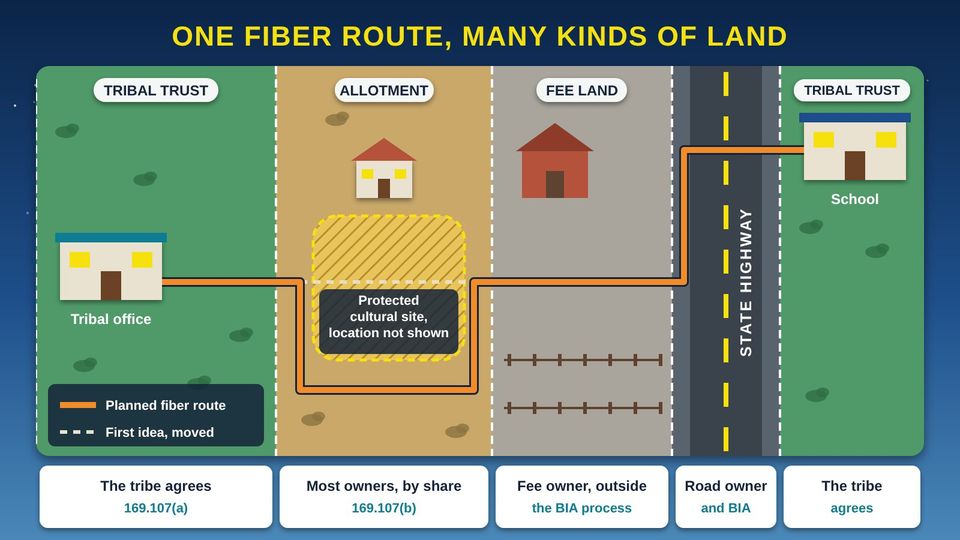
Picture the tribal planning office on a spring morning. The funding came through, the fiber is on order, and a crew is ready to dig. Then someone unrolls the map. The route leaves the tribal office on tribal trust land, crosses an allotment shared by dozens of relatives, cuts across a ranch held in fee, and follows the state highway to the school. Each piece of land has its own rules and its own people who must say yes. This guide walks your team through the BIA (Bureau of Indian Affairs) right-of-way process one piece at a time, so the crew can dig with every permission in hand.
Start here1What a Right-of-Way Is, and Where It Applies2Consent and Compensation3The Application and BIA Review4After the Grant, and Speeding Things UpPractice and quizProgram tools and resources
Start hereWelcome
Listen to the story1:30
What you will learn
- Identify which land on a broadband route is covered by 25 CFR (Code of Federal Regulations) Part 169, and choose the right permission for each piece: a right-of-way, a service line agreement, or a business lease
- Explain who must consent on tribal land and on allotted land, how a majority interest works, and the options for payment, bonds, and insurance
- Put together a complete application and track the BIA (Bureau of Indian Affairs) review deadlines and the steps to take if one is missed
- Manage a grant after approval: changes, service line filings, compliance, and records at the LTRO (Land Title and Records Office)
In this guide
1What a Right-of-Way Is, and Where It AppliesA right-of-way is permission to cross land for one purpose, like a fiber line. This part shows which land the federal rule covers, which kind of permission fits each piece of a network, and how tribal authority carries through. Please note: this guide is general information, not legal advice. Work with your BIA (Bureau of Indian Affairs) Agency realty office and your tribal legal counsel, and check the current rules on eCFR (the Electronic Code of Federal Regulations) before you act.2 pictures2Consent and CompensationEvery right-of-way on trust land starts with consent. On allotted land, that can mean finding and talking with many owners. This part covers who must agree, how payment works, and the bond and insurance rules.1 picture3The Application and BIA ReviewWith consent in hand, you put the package together. BIA's review clock starts only when the package is complete, so a complete package is the fastest path.1 picture4After the Grant, and Speeding Things UpA grant is the start of a long relationship with the land and its owners. This part covers changes, home drops, compliance, records, and what you can do to keep things moving.2 pictures✓Practice and quizTry it yourself, the three things to remember, and a short quiz.
Part 1What a Right-of-Way Is, and Where It Applies
A right-of-way is permission to cross land for one purpose, like a fiber line. This part shows which land the federal rule covers, which kind of permission fits each piece of a network, and how tribal authority carries through. Please note: this guide is general information, not legal advice. Work with your BIA (Bureau of Indian Affairs) Agency realty office and your tribal legal counsel, and check the current rules on eCFR (the Electronic Code of Federal Regulations) before you act.
Listen to this part3:08
Read all 6 details
- 1Tribal trust land. The United States holds this land in trust for the tribe. A right-of-way (ROW) across it is covered by 25 CFR (Code of Federal Regulations) Part 169 and needs the tribe's consent through a tribal authorization. Conditions the tribe sets become conditions of the grant (25 CFR 169.107(a)).
- 2An allotment. This is individually owned Indian land, held in trust or restricted status, often by many relatives who each own an undivided share. Part 169 covers it (169.2). You must notify every owner and get written consent from the owners of the majority interest (169.107(b)).
- 3A protected cultural site. The first idea ran straight through a protected cultural site, so the route was moved around it. The Bureau of Indian Affairs (BIA) must confirm the project follows federal environmental, historic-preservation, and cultural-resource laws (169.123(a)). Maps you share should never show where a site really is.
- 4Fee land. This ranch is fee land, owned outright and not held in trust. Part 169 does not cover it, and the Bureau of Indian Affairs (BIA) will not make your grant depend on rights from fee owners (169.3(b)). Work out permission with the fee owner separately, with help from your legal counsel.
- 5A state highway. A state highway usually sits in a right-of-way that someone else already holds. Ask the road owner, often the state transportation department, and your Bureau of Indian Affairs (BIA) Agency what permission you need to place fiber along it. Put this on your plan from day one.
- 6Tract by tract. The school sits on tribal trust land again, but it is a different tract. Every piece of land the route crosses is its own tract, with its own owners and its own record. List every tract and its land status before you apply.
Listen to this picture2:11
Read all 5 details
- 1Main lines need a right-of-way. The main fiber line runs in a strip of land along the road. On tribal or individually owned Indian land, that strip needs a right-of-way (ROW) grant from the Bureau of Indian Affairs (BIA) under 25 CFR (Code of Federal Regulations) Part 169. Part 169 lists telecommunications and fiber lines as covered uses (169.5).
- 2A home drop is a service line. A service line runs from a main or distribution line to a house, business, or other building. The rule says this includes telephone and internet lines (169.51). It uses a simpler service line agreement, signed by the utility and the landowners, instead of a full right-of-way (169.52).
- 3The connection point and plat. The agreement should cover the services, how damage will be prevented, and how the land will be restored (169.53). Within 30 days, file the signed copy with the Bureau of Indian Affairs (BIA), with a plat or drawing that shows the parcel boundary and this connection point (169.56).
- 4Tower sites fit a lease. A tower site is a fenced area the company uses all the time, not just a strip to pass through. The Bureau of Indian Affairs (BIA) says tower sites, buildings, and access points are generally better suited to a business lease under 25 CFR Part 162, Subpart D.
- 5Plan all three together. Most broadband projects need all three. Also check what already exists: a use already allowed by a lease, a grazing permit, or a tribal land assignment does not need a new right-of-way (169.4(b)(2)).
Read this first: general information, not legal advice
This guide explains the federal right-of-way rules in plain language. It is general information, not legal advice, and it does not replace the rules themselves.
Work with your BIA (Bureau of Indian Affairs) Agency realty office and your tribal legal counsel on every project. Rules and policies change, so check the current 25 CFR (Code of Federal Regulations) Part 169 on eCFR (the Electronic Code of Federal Regulations, at ecfr.gov) before you act.
This guide describes the rule for grants made on or after April 21, 2016. For older grants, only the procedural parts of the current rule apply (25 CFR 169.7).
What the rule says a right-of-way is
Under 25 CFR 169.2, a right-of-way (ROW) is "a legal right to go over or across tribal land, individually owned Indian land, or BIA land for a specific purpose." Tribal land and individually owned Indian land mean the surface held in trust or restricted status, including undivided shares. Telecommunications and fiber lines are covered uses (169.5).
A right-of-way does not include service lines, the short drops to a home or building. Those use a simpler service line agreement (169.51 to 169.56), covered in Part 4.
The current rule was published in the Federal Register in November 2015 (80 FR 72492) and took effect April 21, 2016 (81 FR 14976). Its only change of substance since then added a bond exemption for governments, 169.103(k), effective September 18, 2019 (84 FR 42806).
Which land does Part 169 cover?
| Land on your route | Covered by Part 169? | Who must agree | Rule |
|---|---|---|---|
| Tribal land (trust or restricted, including undivided shares) | Yes | The tribe, by tribal authorization, plus a written agreement if the tribe requires one | 169.2, 169.107(a) |
| Individually owned Indian land (an allotment) | Yes | Notice to all owners and written consent of the owners of the majority interest | 169.2, 169.107(b) |
| BIA land | Yes | Ask your BIA Agency realty office | 169.2 |
| Fee land (owned outright, not in trust) | No. BIA will not make your grant depend on fee owners' rights | The fee owner, outside the BIA process | 169.3(b) |
| Fee shares inside an allotment | Fee shares are not counted toward consent | Confirm the consent math with BIA | 169.3(c) |
| A tract where one Indian landowner, including a tribe, owns 100% of the trust shares | Not covered by Part 169 | Confirm with BIA and tribal legal counsel how this applies to your project | 169.4(b)(1) |
| Land already under a lease, a grazing permit, or a tribal land assignment | Not for uses the lease, permit, or assignment already allows | The holder, under its terms | 169.4(b)(2) |
| Grants made under special acts of Congress | Those acts control | Follow the act | 169.1(d) |
A state highway or county road usually sits in a right-of-way someone else already holds. Ask the road owner and your BIA Agency what you need to place fiber along it.
Which permission fits which piece of the network?
| Piece of the network | Usual permission | Rule | BIA's role |
|---|---|---|---|
| Main and distribution lines along roads | Right-of-way grant | 25 CFR Part 169 | BIA reviews and grants |
| Drop from the line to a home, business, or other building | Service line agreement | 25 CFR 169.51 to 169.56 | File it with BIA within 30 days; no BIA approval needed |
| Tower sites, buildings, and access points | Business lease | 25 CFR Part 162, Subpart D | BIA says these are generally better suited to a business lease |
Tribal authority carries through
Tribal law applies
A right-of-way is subject to tribal law unless it conflicts with federal law, and generally not to state law (169.9).
Jurisdiction stays
A grant does not reduce the tribe's jurisdiction, its power to tax, or the land's status as Indian country (169.10).
Taxes
Improvements in the right-of-way are exempt from state taxes, but the tribe may tax them (169.11).
The tribe sets conditions
Conditions in the tribe's consent become conditions of the grant (169.107(a)). The tribe may also require a statement that the project conforms to tribal law (169.102(b)).
Tribes can run realty work
Tribes may contract or compact realty functions under ISDEAA (the Indian Self-Determination and Education Assistance Act). BIA still makes the grant decision, fair market value waivers, cancellations, and appeals (169.8).
HEARTH Act is for leases
The HEARTH Act (Helping Expedite and Advance Responsible Tribal Home Ownership Act) covers certain lease types, not rights-of-way.
Part 2Consent and Compensation
Every right-of-way on trust land starts with consent. On allotted land, that can mean finding and talking with many owners. This part covers who must agree, how payment works, and the bond and insurance rules.
Listen to this part2:42
Read all 6 details
- 1Why so many owners. When an allotment owner passes on, the land is often split among heirs as undivided shares. After a few generations, one allotment can have dozens of owners, each holding a small share of the whole. This is called fractionation.
- 2Ask BIA for the owner list. You may survey with the landowners' consent; you do not need approval from the Bureau of Indian Affairs (BIA) to survey (25 CFR 169.101). On written request, BIA will give you the owners' names, addresses, and ownership shares so you can negotiate (169.106).
- 3Majority by share, not by headcount. For individually owned land, you must notify every owner and get written consent from the owners of the majority interest (169.107(b)). Here 7 owners hold 54% of the shares, so they are a majority interest, even though most owners did not sign.
- 4Owners who did not sign. Owners who do not consent are still paid. They receive fair market value unless an exception applies (169.112(d)). Fee interests, shares no longer held in trust, are not counted toward consent (169.3(c)).
- 5The count date. The Bureau of Indian Affairs (BIA) counts owners from its records as of the date you apply (169.107(c)). Owners change as people pass on and estates close, so get a fresh owner list close to your application date.
- 6Fifty or more owners. The Bureau of Indian Affairs (BIA) may grant a right-of-way without consent only if four conditions are all met, including 60 days' notice to owners and a 30-day window to object (169.107(b)(1)). Getting consent counts as impracticable when there are 50 or more co-owners (169.107(b)(2)).
Getting consent, step by step
- 1Get consent to survey
You need the landowners' consent to survey, but not BIA approval (25 CFR 169.101).
- 2Ask BIA for owner information
Send BIA a written request. BIA will give you the owners' names, addresses, and ownership shares so you can negotiate (169.106).
- 3Tribal land: get a tribal authorization
The tribe consents by tribal authorization, plus a written agreement if the tribe requires one. The tribe's conditions become grant conditions (169.107(a)).
- 4Allotted land: notify everyone, then count shares
Give notice to all owners and get written consent from the owners of the majority interest, meaning more than half of the shares, not more than half of the people (169.107(b)). BIA counts owners from its records as of your application date (169.107(c)).
- 5Check who may sign
The rules say who may consent for an owner (169.108) and how life estates are handled (169.109). Ask the Agency about minors, estates in probate, and owners who cannot be found.
- 6Know the no-consent exception
BIA may grant a right-of-way across allotted land without consent only if four conditions are all met, including 60 days' notice to owners and a 30-day window to object (169.107(b)(1)). Consent counts as impracticable when there are 50 or more co-owners (169.107(b)(2)).
Compensation: what the rules allow
| Land | Options | Rule |
|---|---|---|
| Tribal land | The tribe may negotiate any amount it chooses | 169.110(a) |
| Tribal land | The tribe may waive valuation by tribal authorization | 169.110(a) |
| Tribal land | The tribe may ask BIA for a fair market value figure before it negotiates | 169.110(b) |
| Tribal land | Otherwise, the default is fair market value | 169.110(c) |
| Allotted land | At least fair market value | 169.112(a) |
| Allotted land | BIA may approve nominal or reduced payment for a tribal utility, for a utility cooperative that directly benefits the land, or under a written owner waiver BIA finds in the owners' best interest | 169.112(b) |
| Allotted land | Valuation may be waived | 169.112(c) |
| Allotted land | Owners who did not consent get fair market value unless an exception applies | 169.112(d) |
| Both | Accepted valuation methods | 169.114 |
Bonds, security, and insurance (25 CFR 169.103)
- Plan for security (a bond or similar). It is required unless waived or exempt (169.103).
- Do not plan on a cash bond. Cash bonds are not accepted (169.103(j)).
- Carry insurance that names the landowners and the United States as additional insureds (169.103(b)).
- On tribal land, BIA defers to the tribe on waivers (169.103(f)).
- On allotted land, ask about a waiver if the majority owners request one, or if you are a tribal utility or a utility cooperative (169.103(f)).
- If your government is barred by law from posting security, ask about the exemption in 169.103(k).
A tribal utility has extra options
A tribal utility can ask BIA for nominal or reduced payment on allotted land (169.112(b)) and for a bond or insurance waiver (169.103(f)). Raise these early with the Agency and put the request in writing.
Part 3The Application and BIA Review
With consent in hand, you put the package together. BIA's review clock starts only when the package is complete, so a complete package is the fastest path.
Listen to this part3:14
Read all 6 details
- 1Steps 1 to 4: before you apply. Map the route and list every tract. Ask the Bureau of Indian Affairs (BIA) in writing for owner lists (25 CFR 169.106). Get landowner consent to survey; BIA approval is not needed to survey (169.101). For tribal land, the tribe acts by tribal authorization (169.107(a)).
- 2Steps 5 and 6: consent and payment. Notify every owner of allotted land and gather written consent from the majority interest (169.107(b)). Settle compensation: a negotiated amount, fair market value, or a waiver the rules allow (169.110 and 169.112).
- 3Steps 7 and 8: reviews and security. Environmental and cultural review documents are part of a complete package (169.123(b)). Line up the bond or other security and insurance, or a waiver or exemption that fits (169.103). Start these early, because they can take the longest.
- 4Steps 9 and 10: submit and check. Send the package with everything 169.102 lists. There is no required form, but the Bureau of Indian Affairs (BIA) offers an optional one and a checklist. BIA must promptly tell you whether the package is complete (169.123(b)).
- 5Steps 11 and 12: the decision. Within 60 days of a complete package, the Bureau of Indian Affairs (BIA) must grant, deny, return it, or ask for more time; if it asks, it must decide within 30 days of that letter (169.123(b)). BIA must grant unless it has a compelling reason not to (169.124). The grant takes effect when approved and is recorded in the Land Title and Records Office (LTRO) (169.301 to 169.302).
- 6If the clock runs out. A missed deadline does not mean your right-of-way is approved. Send a written notice to compel to the Regional Director, who has 15 days to act; then to the Bureau of Indian Affairs (BIA) Director, who has 15 days; then you may appeal to the Interior Board of Indian Appeals (169.304).
What goes in the application (25 CFR 169.102)
There is no required form (169.102(c)). BIA publishes an optional form (OMB 1076-0181, an Office of Management and Budget control number) and a checklist. A complete package includes:
- The tracts the right-of-way crosses
- The purpose (for example, a buried fiber line)
- The duration you are asking for
- A legal description of the right-of-way
- A map of definite location (the surveyed route)
- Security: a bond or other security, or a waiver or exemption
- Proof that you gave notice to the landowners
- The consents (tribal authorization, owners' written consents)
- A valuation, or a waiver of valuation
- Environmental and archaeological reports
- A tribal conformance statement, if the tribe requires one
Environmental and cultural review
| Review | What it means for you | Source |
|---|---|---|
| Federal environmental, historic-preservation, and cultural-resource laws | BIA must identify the project's effects and confirm it complies, under laws such as NEPA (the National Environmental Policy Act), Section 106 of NHPA (the National Historic Preservation Act), and ESA (the Endangered Species Act) | 25 CFR 169.123(a) |
| NEPA paperwork | The NEPA documents are part of a complete package | 169.123(b) |
| Finds during construction | Work stops if cultural resources that were not reported are found | 169.125(c)(4) |
| NTIA categorical exclusions | NTIA (the National Telecommunications and Information Administration) adopted 30 NEPA categorical exclusions, effective April 2, 2024, that cover buried and aerial fiber in existing rights-of-way. Ask NTIA and BIA whether one fits your project | NTIA (2024) |
| Extraordinary circumstances | A categorical exclusion cannot be used where extraordinary circumstances exist, including Native American traditional cultural properties, Indian sacred sites, and violations of tribal law | NTIA (2024) |
| Tribal Broadband Connectivity Program (TBCP) projects | NTIA and BIA signed an agreement on August 9, 2022, to coordinate environmental, historic-preservation, and cultural review for TBCP projects | NTIA (2022) |
BIA's clocks, and what to do if one runs out
- 1BIA checks the package
BIA must promptly tell you whether the package is complete (169.123(b)). Write down the date you get that answer.
- 260 days to decide
Within 60 days of a complete package, BIA must grant, deny, return the package, or ask for more time (169.123(b)).
- 330 more days, only in writing
If BIA asks for more time, it must decide within 30 days of that letter (169.123(b)).
- 4A strong standard
BIA must grant the right-of-way unless it finds a compelling reason not to (169.124).
- 5Silence is not approval
A missed deadline does not mean the right-of-way is deemed approved. Do not start building.
- 6Escalate in writing
Send a written notice to compel to the Regional Director, who has 15 days to act. If there is still no decision, send one to the BIA Director, who has 15 days. Then you may appeal to the IBIA (Interior Board of Indian Appeals) (169.304).
- 7Grant recorded
The grant takes effect on the date BIA approves it and is recorded in the LTRO (Land Title and Records Office) (169.301 to 169.302).
Mail or email? Ask first
BIA's own web pages disagree about whether to mail or email a broadband right-of-way package. Before you send it, confirm with your Agency realty office how and where to submit, and keep proof of the date it arrived.
Part 4After the Grant, and Speeding Things Up
A grant is the start of a long relationship with the land and its owners. This part covers changes, home drops, compliance, records, and what you can do to keep things moving.
Listen to this part2:43
Read all 6 details
- 1Copper to fiber is a change of use. The Bureau of Indian Affairs (BIA) policy memo NPM-TRUS-48 (National Policy Memorandum) treats switching a line from copper to fiber as a new use, not maintenance. Before you upgrade inside an old right-of-way, ask your BIA Agency what approval you need, such as an amendment.
- 2Selling or transferring the grant. Passing a right-of-way to another company is an assignment. It needs Bureau of Indian Affairs (BIA) approval unless the grant itself expressly allows assignment without it (25 CFR 169.207).
- 3Using the grant for a loan. A lender may want the right-of-way as security for a loan. A mortgage of a right-of-way requires express permission (169.210), and the Bureau of Indian Affairs (BIA) decides on it.
- 4How long the grant lasts. The grant lasts as long as it says. On tribal land, the Bureau of Indian Affairs (BIA) defers to the term the tribe sets. On allotted land, 50 years total, including renewals, is generally reasonable for uses other than oil and gas (169.201). Renewals follow 169.202 and 169.203.
- 5New homes along the line. Each new home drop needs a service line agreement signed before construction by the right people: on tribal land, the tribe or the authorized occupants or users; on allotted land, the owners or the authorized occupants or users (169.54). File each one with the Bureau of Indian Affairs (BIA) within 30 days (169.56).
- 6A 30-day answer. For amendments, assignments, and mortgages, the Bureau of Indian Affairs (BIA) has 30 days to decide (169.204 to 169.212). Put each request date on your tracker so you know when the answer is due.
Listen to this picture2:01
Read all 5 details
- 1The Title Status Report. A Title Status Report (TSR) shows a tract's legal description, its owners, and its encumbrances, including rights-of-way. The Land Title and Records Office (LTRO) certifies it. Ask your Bureau of Indian Affairs (BIA) Agency realty office for current TSRs for every tract on your route.
- 2Encumbrances. An encumbrance is anything already recorded against the land, such as an older power line right-of-way. Checking this list early shows what is already there, who holds it, and whether an existing grant or lease already covers part of your plan.
- 3The Land Title and Records Office. The Land Title and Records Office (LTRO) records title documents for trust land. Your approved right-of-way grant is recorded there (25 CFR 169.301 to 169.302), and so are filed service line agreements (169.56). The Bureau of Indian Affairs (BIA) has 18 LTROs across the country.
- 4TAAMS. The LTRO keeps title records in TAAMS (Trust Asset and Accounting Management System) Title. This is the federal system behind the owner lists and Title Status Reports (TSRs) that you receive.
- 5Keep your own file. Keep a copy of every request, letter, and grant, with the date you sent or received it. The Government Accountability Office (GAO) found that only 5% of processed rights-of-way it reviewed (52 of 1,146) had all key dates recorded. Your own dates are your best tool if you need to escalate.
Grant terms and later changes
| Topic | What the rule says | Rule |
|---|---|---|
| Duration | What the grant states. On tribal land, BIA defers to the tribe's term. On allotted land, 50 years total including renewals is generally reasonable for uses other than oil and gas | 169.201 |
| Renewal | Follow the renewal rules and your grant's terms | 169.202 to 169.203 |
| Amendments, assignments, mortgages | Each gets a BIA decision within 30 days | 169.204 to 169.212 |
| Assignment (transfer to another company) | Needs BIA approval unless the grant expressly allows it without approval | 169.207 |
| Mortgage | Requires express permission | 169.210 |
| Copper to fiber | BIA's 2025 policy memo treats this as a new use, not maintenance; ask the Agency what approval you need | NPM-TRUS-48 |
Service lines: home drops done right
- 1Sign before you build
The utility and the landowners sign the agreement (169.52). Before construction, get signatures from the tribe or the authorized occupants or users on tribal land (the tribe must also sign if it asks), or from the owners or the authorized occupants or users on allotted land (169.54).
- 2Cover the basics
Say what services you will provide, how you will prevent damage, and how you will restore the land (169.53). No valuation is required (169.55).
- 3Draw a plat
Attach a plat or drawing that shows the parcel boundary and the connection point (169.56).
- 4File within 30 days
File the signed copy with BIA within 30 days so it can be recorded in the LTRO (169.56). Filing, not BIA approval, is what keeps a drop outside the full right-of-way process (169.4(b)(3)). To be safe, count the 30 days from the day the agreement is signed.
Compliance and enforcement
| If this happens | The rule | Rule |
|---|---|---|
| BIA finds a violation | A notice of violation gives 10 business days to fix it | 169.404 |
| The violation is not fixed | BIA may cancel the grant | 169.405 |
| The right-of-way is not used | Cancellation for non-use takes 2 years in a row | 169.408 |
| Someone stays after the grant ends | Holdover rules apply | 169.410 |
| Someone uses the land without a grant | Trespass rules apply | 169.413 |
| The tribe wants its own remedies | Tribes may negotiate their own remedies and investigate violations under tribal law | 169.402, 169.403 |
Speeding things up
BIA issued NPM-TRUS-48 (a National Policy Memorandum) on September 3, 2025. It tells BIA staff to encode (enter) a broadband package within 3 business days and finish the completeness review within 7 business days. It sends approved grants to the LTRO, and it says one application can cover several tracts that touch each other. An earlier memo, NPM-TRUS-44 (April 15, 2022, revised April 4, 2024), set a 5-business-day completeness review.
The memo says it expires September 3, 2026. We could not confirm whether it has been renewed or replaced. Ask your Agency whether NPM-TRUS-48 or a newer memo is in effect, and name it in your cover letter if it is.
Delays are real. The GAO (Government Accountability Office) found in 2023 that only 5% of processed rights-of-way it reviewed (52 of 1,146) had all key dates recorded, that BIA had 95 Realty vacancies, that 28% of LTRO examiner positions were vacant, and that survey reviews can back up. One tribe told GAO that slow right-of-way communication held back broadband upgrades. An earlier GAO report found there is no national tribal broadband strategy.
Common pitfalls to avoid
- Starting construction before the grant is approved, or treating a missed deadline as approval
- Forgetting fee land, which sits outside the BIA process, and state or county roads, where you must also ask the road owner
- Counting owners instead of shares when you tally consent
- Using an old owner list; BIA counts owners as of your application date
- Sending an incomplete package, so the 60-day clock never starts
- Planning on a cash bond, which is not accepted
- Treating a copper-to-fiber upgrade as routine maintenance
- Putting a tower site in a right-of-way instead of asking about a business lease
- Missing the 30-day filing for service line agreements
- Not keeping your own dated record of every letter and request
ReviewPractice and quiz
Listen to the practice steps1:28
Try it with your team: map one route
About 30 minutes with a map of one planned route, the ROW Project Tracker, and the ROW Readiness Checklist.
- Pick one planned route, such as the tribal office to the school. Draw it on a printed map or in your GIS (Geographic Information System) software.
- Ask your BIA Agency realty office how to get Title Status Reports for each tract the route crosses, and mark each tract's land status: tribal trust, allotment, BIA land, fee land, or road.
- Enter each tract on the Tracts sheet of the tracker. Write who must consent: the tribe by tribal authorization, the majority interest of allotment owners, or someone outside the BIA process.
- For each allotment, write the number of owners. Flag any with 50 or more owners to discuss with the Agency.
- Mark every home or building that will need a service line agreement, and any tower site that may need a business lease.
- List your questions for the Agency and your tribal legal counsel, and set a date to meet.
Remember
Each tract has its own rules and owners
Allotted land needs consent of the majority interest
A missed BIA deadline is not an approval
Check what you learned
1. Your fiber route crosses tribal trust land, an allotment, and a ranch held in fee. Which pieces does the BIA (Bureau of Indian Affairs) right-of-way process cover?
Part 169 covers tribal land and individually owned Indian land (169.2). Fee land is outside it, and BIA will not make your grant depend on fee owners (169.3(b)), so you work that out with the fee owner separately.
2. An allotment on your route has 40 owners. You have notified all of them, and 12 owners holding 55% of the shares have signed. Is that enough consent?
On individually owned land you need written consent from the owners of the majority interest, counted by shares, after notice to all owners (169.107(b)). The owners who did not sign are still paid fair market value unless an exception applies.
3. BIA said your package was complete 75 days ago. You have no decision and no letter asking for more time. What should you do?
A missed deadline is not an approval. Under 25 CFR (Code of Federal Regulations) 169.304, you send a notice to compel to the Regional Director, then the BIA (Bureau of Indian Affairs) Director, then you may appeal to the Interior Board of Indian Appeals.
4. Last week your crew connected 12 homes on allotments, each with a signed service line agreement. What still needs to happen?
Service lines do not need BIA approval, but each signed agreement, with a plat showing the parcel boundary and connection point, must be filed with BIA within 30 days so it can be recorded (169.56).
5. Your utility wants to pull out an old copper line in an existing right-of-way and put in fiber. How should you treat it?
BIA's policy memo NPM-TRUS-48 (National Policy Memorandum) treats a switch from copper to fiber as a new use, not maintenance. Ask the Agency before you start, and plan for an amendment if needed.
ResourcesProgram tools and resources
Program tools
Free to use, copy, and adapt for your community.
DOCXROW Readiness ChecklistEvery application element, consent, review, and bond, with 25 CFR section numbers and space for notes. Editable Word file.DownloadPDFROW Readiness ChecklistThe same checklist, ready to print for a planning meeting.DownloadXLSXROW Project TrackerTrack tracts and consent shares, BIA deadlines and escalation dates, and 30-day service line filings. Dates are calculated for you.DownloadDOCXService Line Agreement StarterA plain-language outline of what 25 CFR 169.53 to 169.56 require. A sample to adapt with tribal legal counsel, not a legal form.Download
Questions to ask your BIA Agency realty office
- How do you want the package submitted: mail, email, or both? Who is our contact?
- Is NPM-TRUS-48 still in effect, or has a newer memo replaced it?
- Can one application cover all the tracts on this route that touch each other?
- How do we get current Title Status Reports and owner lists for each tract?
- Which environmental and cultural reviews will you need for this route, and can an existing categorical exclusion be used?
- What bond, insurance, or waiver will you accept for our project?
- How should we file service line agreements, and how do we get proof of filing?
One more reminder
This guide is general information, not legal advice. Confirm every step with your BIA Agency realty office and your tribal legal counsel, and read the current 25 CFR Part 169 on eCFR before you act.
Words to know
- ROW
- Right-of-way. A legal right to go over or across tribal land, individually owned Indian land, or BIA (Bureau of Indian Affairs) land for a specific purpose, such as a fiber line.
- BIA
- Bureau of Indian Affairs. The federal agency in the U.S. Department of the Interior that reviews and grants rights-of-way across trust and restricted land.
- CFR
- Code of Federal Regulations. The official set of federal rules. The right-of-way rules are Title 25, Part 169, written 25 CFR Part 169.
- eCFR
- Electronic Code of Federal Regulations. The free government website, ecfr.gov, that shows the current federal rules.
- Tribal land
- Land, or an undivided share of land, held in trust or restricted status for a tribe.
- Allotment
- Individually owned Indian land. Land held in trust or restricted status for one or more individual Indian owners.
- Fee land
- Land owned outright, not held in trust or restricted status. The BIA right-of-way rule does not cover it.
- Fractionation
- When ownership of an allotment is split into smaller and smaller undivided shares as it passes to heirs over generations.
- Majority interest
- Owners who together hold more than half of the shares in a tract. It is counted by shares, not by number of people.
- Tribal authorization
- A tribal resolution, ordinance, or other official tribal document that approves an action, such as consent to a right-of-way.
- Service line
- A line from a main or distribution line to a house, business, or other building, including telephone and internet drops.
- Business lease
- A lease under 25 CFR (Code of Federal Regulations) Part 162, Subpart D. BIA (Bureau of Indian Affairs) says it generally fits tower sites, buildings, and access points better than a right-of-way.
- Fair market value
- The amount the right to use the land would be worth in an open market, found through an accepted valuation method.
- LTRO
- Land Title and Records Office. The BIA (Bureau of Indian Affairs) office that records title documents for trust land and certifies Title Status Reports.
- TSR
- Title Status Report. A certified report showing a tract's legal description, owners, and encumbrances, including rights-of-way.
- TAAMS
- Trust Asset and Accounting Management System. The federal computer system where title records for trust land are kept.
- NEPA
- National Environmental Policy Act. A federal law that requires agencies to study the environmental effects of actions they approve, such as a right-of-way grant.
- Categorical exclusion
- A kind of action an agency has found does not normally have significant environmental effects, so it needs less NEPA (National Environmental Policy Act) paperwork, unless extraordinary circumstances exist.
Learn more
- eCFR: 25 CFR Part 169, Rights-of-Way on Indian LandThe current rule, updated as it changes. Always check it before you act.
- BIA: Apply for broadband right-of-way in Indian CountryBIA's page for broadband applicants, with the optional form and checklist.
- BIA: 52 IAM 9-H, Rights-of-way on Indian lands handbookThe handbook BIA staff use to process rights-of-way.
- BIA: NPM-TRUS-48, streamlining broadband rights-of-wayThe 2025 policy memo with faster review targets. Ask whether it is still in effect.
- NTIA: Newly adopted NEPA categorical exclusionsThe 30 categorical exclusions for broadband work, and when they cannot be used.
- GAO: Timely delivery of BIA real estate servicesThe 2023 GAO report on delays, records, and staffing in BIA realty.
For teachers and digital navigators: how to run this class (90-minute staff training)
Lesson plan
- 10 minOpen with the planning office story and the Read this first callout. Name who covers realty, planning, the utility, legal counsel, and Council updates, and who is the main contact with the BIA Agency realty office.
- 15 minPart 1: explore the route map and the Which Permission picture. On your own map, color each tract by land status and mark drops and tower sites.
- 15 minPart 2: explore the allotment picture. Work a consent tally for a sample allotment: owners, shares signed, and whether a majority interest is reached.
- 15 minPart 3: walk the twelve steps. In the Timeline sheet, give each step an owner and a target date, and review the escalation ladder.
- 10 minPart 4: changes and records. Decide who files service line agreements within 30 days and who keeps the dated project file.
- 20 minDo the team activity on one real route. Write the list of questions for the Agency and for tribal legal counsel.
- 5 minRun the quiz with a show of hands, review the Remember cards, and set the date of the first Agency meeting.
What you need
- Projector or large TV for the pictures
- The ROW Readiness Checklist, printed, one per person
- A large printed map of one planned route, or your GIS (Geographic Information System) map on screen
- The ROW Project Tracker open on a laptop
- Current Title Status Reports for two or three tracts, if the Agency can provide them; keep owner information private
- A printed copy of 25 CFR Part 169 from eCFR
Talk about it
- Which tracts on our routes are allotments with many owners, and how will we reach every owner respectfully and in plain language?
- What conditions should our tribe attach to rights-of-way, and should we require a tribal conformance statement?
- Who will keep our project dates, and what will we do the day after a BIA deadline passes without an answer?
The PowerPoint slides follow this plan, with the story and every picture detail in the speaker notes.
References
- Bureau of Indian Affairs. (n.d.). Apply for broadband right-of-way in Indian Country. https://www.bia.gov/service/broadband-access/apply-broadband-right-of-way
- Bureau of Indian Affairs. (2022a). 51 IAM 1-H: Land titles and records handbook. https://www.bia.gov/sites/default/files/dup/assets/public/raca/handbook/pdf/51-iam-1-h_ltro-handbook_final_signed_508.pdf
- Bureau of Indian Affairs. (2022b). 52 IAM 9-H: Rights-of-way (ROW) on Indian lands handbook. https://www.bia.gov/policy-forms/handbooks/52-iam-9-h-rights-way-row-indian-lands-handbook
- Bureau of Indian Affairs. (2025). NPM-TRUS-48: Streamlining the rights-of-way application processes for broadband infrastructure projects across Indian trust and restricted land. https://www.bia.gov/sites/default/files/dup/assets/public/raca/national_policy_memoranda/pdf/npm-trus-48_streamlining-rows-broadband_final_signed_508.pdf
- National Telecommunications and Information Administration. (2022, August 9). NTIA and BIA sign agreement to streamline environmental permitting for high-speed internet projects on tribal lands. https://broadbandusa.ntia.gov/news/latest-news/ntia-and-bia-sign-agreement-streamline-environmental-permitting-high-speed
- National Telecommunications and Information Administration. (2024). Notice of newly adopted NEPA categorical exclusions. https://broadbandusa.ntia.gov/funding-programs/policies-waivers/Notice_of_Newly_Adopted_NEPA_Categorical_Exclusions
- Rights-of-Way on Indian Land, 25 C.F.R. pt. 169 (2026). https://www.ecfr.gov/current/title-25/chapter-I/subchapter-H/part-169
- Rights-of-Way on Indian Land, 80 Fed. Reg. 72492 (November 19, 2015). https://www.federalregister.gov/documents/2015/11/19/2015-28548/rights-of-way-on-indian-land
- Rights-of-Way on Indian Land, 81 Fed. Reg. 14976 (March 21, 2016). https://www.gpo.gov/fdsys/pkg/FR-2016-03-21/html/2016-06269.htm
- Rights-of-Way on Indian Land; Bond Exemption, 84 Fed. Reg. 42806 (August 19, 2019). https://www.govinfo.gov/content/pkg/FR-2019-08-19/html/2019-17781.htm
- U.S. Department of the Interior. (2025, September 8). Interior cuts red tape, expedites broadband infrastructure development in tribal communities [Press release]. https://www.doi.gov/pressreleases/interior-cuts-red-tape-expedites-broadband-infrastructure-development-tribal
- U.S. Government Accountability Office. (2022). Tribal broadband: National strategy and coordination framework needed to increase access (GAO-22-104421). https://www.gao.gov/products/gao-22-104421
- U.S. Government Accountability Office. (2023). Tribal issues: Bureau of Indian Affairs should take additional steps to improve timely delivery of real estate services (GAO-24-105875). https://www.gao.gov/assets/d24105875.pdf
Building a digital equity program?
Numu helps tribal governments plan, fund, and run broadband and digital equity programs. We are glad to talk through your plans.
Contact our team